Discover Lung Khuy cave: A must-visit stop on the Ha Giang Loop
Lung Khuy Cave is a destination where tourists can appreciate the natural beauty of the Northeastern mountains and forests. They can explore impressive geological formations and learn about the culture of traditional Hmong villages. Although the cave was only discovered in 2015, it has held deep cultural significance for the local Hmong people for generations. During the Ha Giang Loop, tourists can easily visit Lung Khuy Cave, trek through its pathways, and discover the “sacred well” hidden among the stunning stalactites.
Location and the origin of Lung Khuy cave’s name
Lung Khuy cave is located in Lung Khuy Commune, Quan Ba District, about 5km from Tam Son Town and roughly 55km from Ha Giang City (now part of Tuyen Quang Province). It is one of the largest and most beautiful caves on the Ha Giang Plateau, stretching over 500m in length and reaching a depth of more than 3m. The cave was discovered and surveyed in 2015, when stairways and walkways were built to make it accessible for tourism.
The local Hmong people have been aware of this cave for generations. Its name, Lung Khuy, is the same as the nearby Hmong village at the foot of the mountain, and it means “Dragon in the Rock Crevice.” According to legend, the area once suffered from a severe drought, leaving the villagers without water. They climbed to the mountaintop to pray for rain, and the heavenly god created a spring hidden deep inside the cave. A Dragon Deity was then sent to guard this life-giving source and protect the village.
The Dragon Deity transformed into a Hmong young man and asked the heavens to bring rain, ensuring the underground spring would never dry up. Thanks to this, all living things thrived, and the villagers enjoyed a prosperous life. The young man later married a Hmong girl from the village, and together they lived inside the cave. From then on, the villagers referred to it as Lung Khuy Cave.
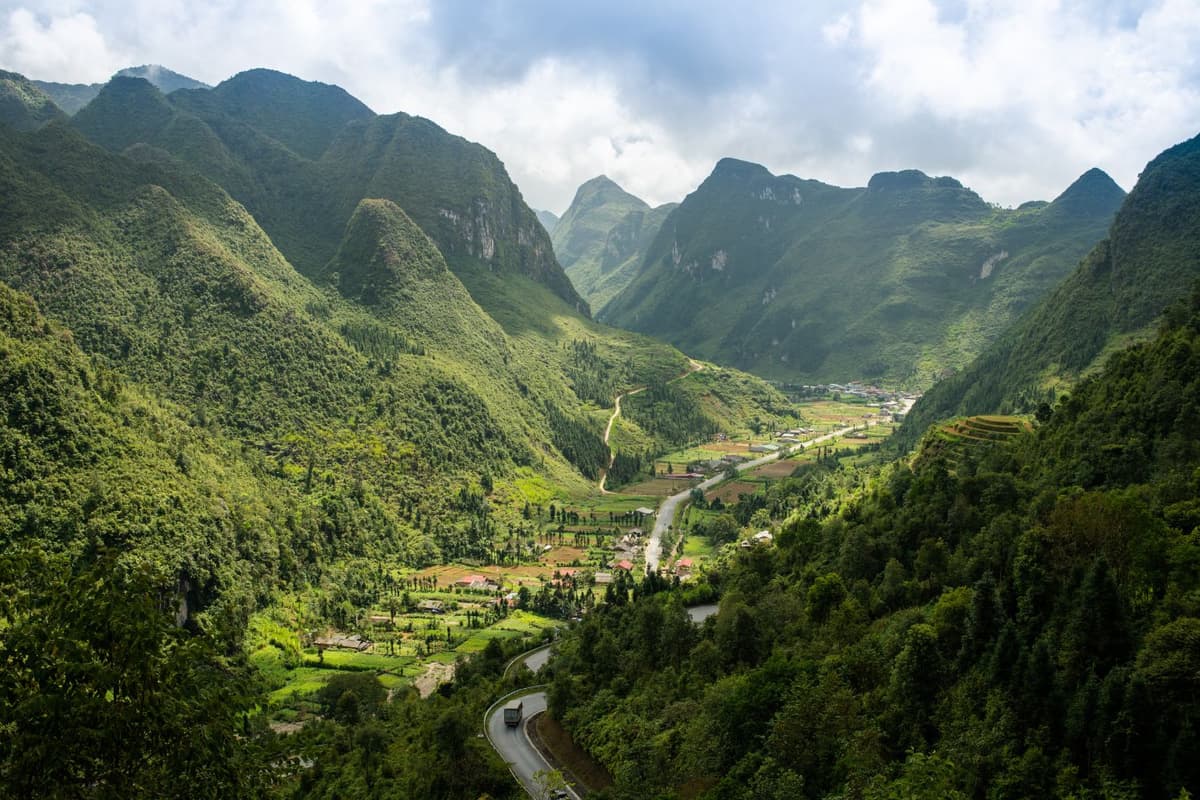
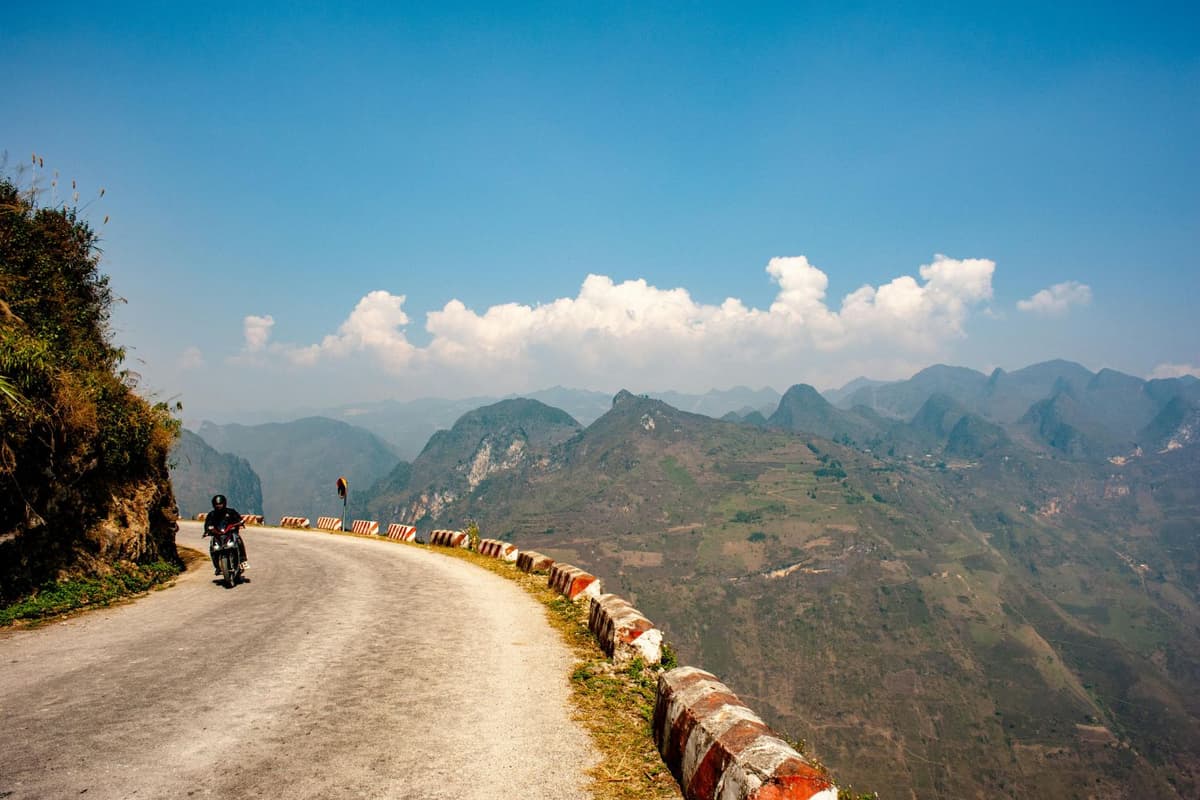
Lung Khuy Cave is located along the Ha Giang Loop, so travelers can get there by motorbike, car, and so on
How to get to Lung Khuy cave
Lung Khuy Cave is located halfway up the mountain, about 2km from Lung Khuy Village and the main road. This is accessible via a small trail with gentle slopes. Tourists can reach the cave by car, motorbike, or other means of transport, following these directions:
- From Tam Son Town, tourists can follow National Highway 4C. At the junction of Nguyen Trai Street and Highway 4C, turn left, go about 50 meters, then turn left again onto the road leading to Lung Khuy Cave. From there, continue around 2.5km to the village at the foot of the mountain, where you can park your vehicle and hike up to the cave entrance located halfway up the mountain.
- From Ha Giang City, tourists can take National Highway 4C for about 55km to reach the village at the foot of the mountain. From there, it’s a 2km hike up to the entrance of Lung Khuy Cave.
The entrance fee to Lung Khuy Cave is 30,000 VND, with tickets available at the booth near the cave entrance.
Currently, Ha Giang has no airport or train station, so tourists from other provinces can fly to Hanoi first, then continue their journey to Ha Giang by bus, car, or motorbike etc.
Opening hours and entrance fee of Lung Khuy Cave
The entrance fee to Lung Khuy Cave is USD 1.15. After parking and walking up to the cave entrance, travelers can purchase tickets at the ticket booth located nearby. Lung Khuy Cave opens from 8:00 AM, and it is recommended to visit between 8:00 AM and 4:00 PM to ensure enough time for trekking and exploring the cave.
Tips for visiting Lung Khuy Cave
To ensure a smooth and enjoyable visit to Lung Khuy Cave in Ha Giang, tourists should prepare the following:
- Wear shoes with a good grip and comfortable clothing.
- Bring water and snacks to stay energized during the hike.
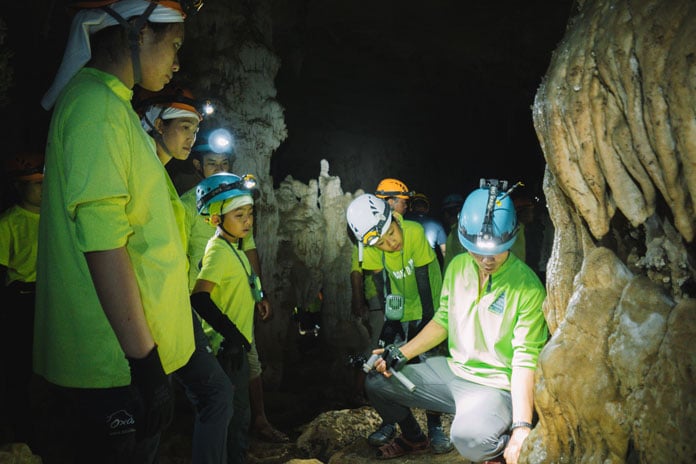
- Carry a small flashlight to better see geological formations and darker sections of the cave.
- Keep the area clean—do not litter inside the cave or along the trail.
- Respect local culture when passing through Hmong villages.
Best time to visit Lung Khuy cave
The best time to visit Lung Khuy Cave in Vietnam, as well as to experience the Ha Giang Loop, is during spring and autumn, when the weather is mild, the vegetation is lush, and many kinds of flowers are in full bloom. Ha Giang has four distinct seasons, each giving the natural landscape its own unique beauty:
- February – April: Spring in Ha Giang. The early days of the season can still be a bit chilly, but the weather gradually becomes warmer. During this time, villages and forests are covered with the vibrant colors of blossoms. There are the pink of peach flowers, the pure white of plum blossoms, the fiery red of bombax flowers, among others.
- May – August: Summer in Ha Giang, which is also the rainy season. From May to June comes the “water pouring season,” when the terraced rice fields are filled with water, shimmering like giant mirrors reflecting the sky and clouds.
- September – November: Autumn in Ha Giang is also the harvest season, when the terraced rice fields turn golden, stretching from the mountaintops down to the valleys. This is the peak time for tourists to visit, capturing stunning photos of the peaceful countryside and watching local people in traditional attire harvesting rice in the fields.
- December – January: Winter in Ha Giang, when the northeast monsoon brings cold weather. Despite the chill, traditional villages under the misty sky offer a peaceful charm, while flowers such as buckwheat and golden mustard bloom even more vibrantly, adding bright colors to the landscape.
Top attractive Lung Khuy cave activities for tourists
Lung Khuy Cave is the largest and most magnificent cave with diverse geological formations in Quan Ba District, Ha Giang (now merged with Tuyen Quang). Tourists visiting Lung Khuy can trek up to the cave entrance halfway up the mountain, explore its illuminated walkways inside, and learn about the local Hmong culture.
1. Conquer Lung Khuy cave hiking trail
To reach the cave entrance, tourists can park their vehicles at local houses at the foot of the mountain. They will hike about 2km along a trail with concrete steps and gentle slopes winding up the hillside. The path is fairly even, surrounded by forest scenery, and along the way, tourists can enjoy panoramic views of vast valleys and rolling mountains in the distance. During the rice harvest season or buckwheat flower season, the landscape becomes even more vibrant, offering both a sense of adventure and the joy of immersing in nature.
2. Explore the geological inside Lung Khuy cave
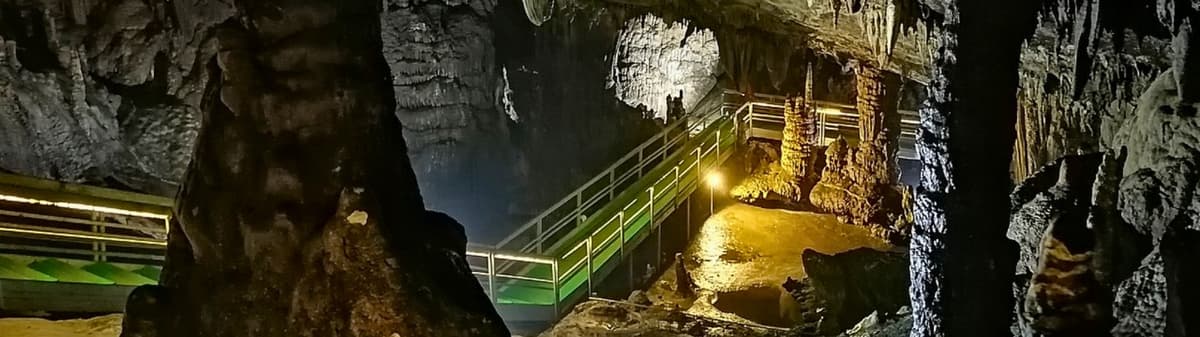
At the entrance, tourists will find Lung Khuy Cave rather modest, with a small opening, a low ceiling, and a staircase partially hidden by large rock walls. This narrow, dim passage soon opens up into a vast chamber filled with massive stalactites and stalagmites, with spacious stairways illuminated by lights leading off in different directions.
The path to the right is shorter, with two short staircases leading to chambers that feature massive stalactites and a flowstone wall rising more than 2m high. Returning to the left-hand stairway, tourists can venture deeper into the cave along a longer, steeper, and more winding route. The stalactite formations in this direction are more complex and striking, with shapes resembling stone pillars, a “forest of stalagmites,” and even figures that locals call the Stone Goddess, among others.
Near the end of the cave, tourists will come across a formation known as the “Golden Waterfall,” where a massive flowstone wall and dozens of smaller cascades layer down from the ceiling in a breathtaking display. At the end of the staircase lies a dark abyss with no visible bottom. From this point, tourists can continue along a concrete walkway on the cave floor, getting a closer look at the giant stalactite formations.
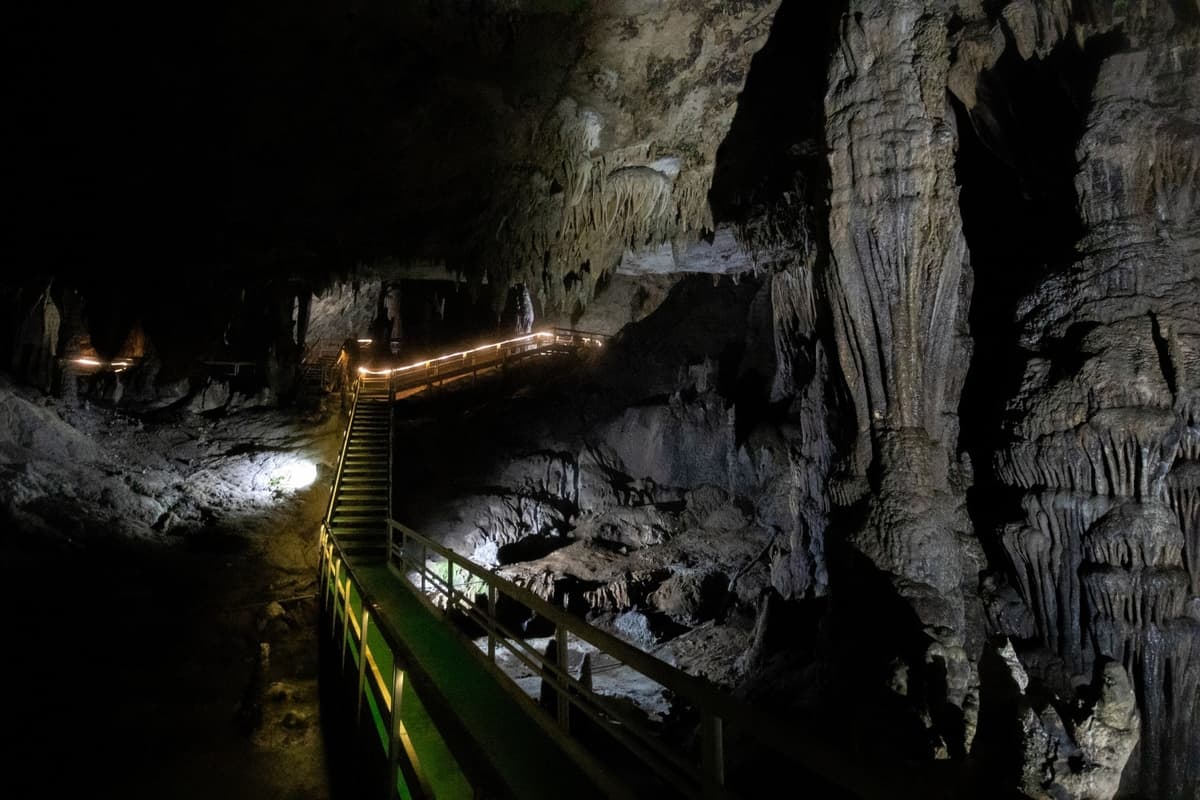
Inside Lung Khuy Cave, a walkway system and lighting have been installed, making it easier for visitors to explore
3. Discover the sacred well amidst the stalactite forest
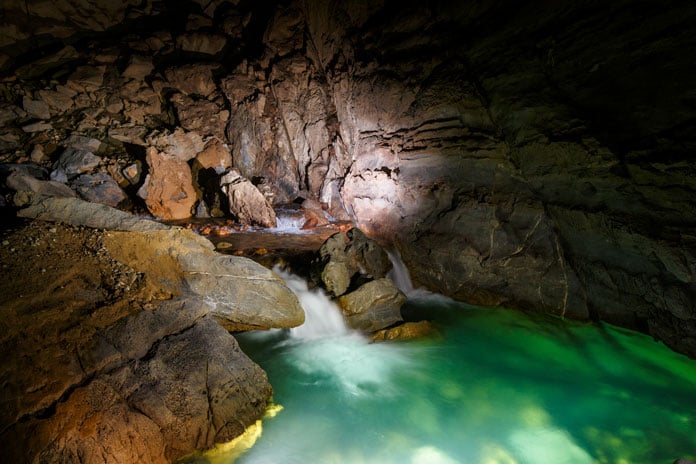
On the way back toward the cave entrance along the lower walkway, tourists will notice a sign pointing to the “Wishing Well.” This is an underground water source inside the cave, known by locals as the “Sacred Well.” The path to reach it is more challenging, with narrow rock passages, low ceilings blocking parts of the way, and slippery cave floors made damp by the constant underground water flow.
Though the path is a bit tricky, it’s an exciting journey that leads tourists to cave chambers with flat sandy floors and clusters of stalactites hanging from the ceiling. As the route goes deeper, the passage becomes narrower and lower, eventually opening into a stalactite “forest” illuminated by soft lighting. Here, the formations curve gracefully like stone curtains, but rise upward from the cave floor instead of hanging down.
Tourists then continue along a narrow passage, squeezing past countless stalagmites clustered together like a primeval stone forest, surrounding the sacred well described in Hmong legends. This underground well is where many visitors stop to pray, believing in the mystical blessings of nature.
What to Eat When Visiting Lung Khuy Cave?
Tourists visiting Lung Khuy Cave can enjoy a variety of Ha Giang’s famous local specialties, including:
- “Thang Co” is the most famous traditional dish of the Hmong people. It is a stew made from horse meat and bones, simmered with a variety of mountain herbs and spices, creating a rich and distinctive flavor.
- Ha Giang corn wine is brewed from upland corn and forest leaf yeast. This local drink has a fragrant, slightly sweet taste that is smooth and not too strong—perfect to enjoy alongside the highland specialties.
- “Thit trau gac bep” is a signature dish of the Thai and Hmong people. Fresh buffalo meat is marinated with spices such as mac khen seeds, doi seeds, ginger, and lemongrass, then hung above the kitchen fire to be smoked. The result is a flavorful dish with a slightly spicy kick and a distinctive smoky aroma, perfect as a drinking snack or a unique gift to bring home.
- Buckwheat cake has a mildly sweet and nutty flavor with a soft, chewy texture. It is usually grilled over hot charcoal, allowing tourists to enjoy its gentle aroma while savoring it warm.
- Five-colored sticky rice is a traditional dish of the Tay and Nung people, often prepared during festivals. The rice is naturally dyed using forest leaves such as magenta plant leaves, turmeric, and red sticky rice leaves, creating five vibrant colors—red, yellow, green, purple, and white—symbolizing the five elements. This dish is not only visually stunning but also fragrant, sticky, and rich in meaning, reflecting the deep bond between the people and the mountains.
- Au Tau porridge is made from the au tau root, a type of wild mountain tuber. Through careful preparation, it becomes a nutritious dish that warms the body, relieves colds, and promotes restful sleep. Its flavor is slightly bitter at first, but as you eat, it reveals a rich, creamy, and uniquely satisfying taste.
Suggested nearby Lung Khuy cave’s attractions
Lung Khuy Cave is located along the travel route to the Dong Van Karst Plateau, Tu San Canyon, Lung Cu Flag Tower, and many other famous attractions. Tourists can easily combine a visit to the cave with these stops as part of their Ha Giang Loop adventure.
1. Quan Ba Heaven Gate:
Quan Ba Heaven Gate is about 6.7 km from Lung Khuy Cave, located along National Highway 4C. Traveling from Ha Giang City, tourists will pass through this spot first. It’s an ideal viewpoint to admire the panoramic scenery of Tam Son Town and the lush green valley below. From here, you can also see the famous Fairy Twin Mountains, with their strikingly round, side-by-side peaks.
2. Ban An Stream:
Ban An Stream is about 82 km from Lung Khuy Cave. Here, tourists can take a small wooden raft drifting along the clear stream to reach Tham Lin cave, hidden within the cliffs. The stream has fresh, crystal-clear water all year round and is surrounded by pristine mountains and forests. The path leading to the stream is still a dirt road, preserving the rustic beauty of the highlands.
3. Tu San Canyon:
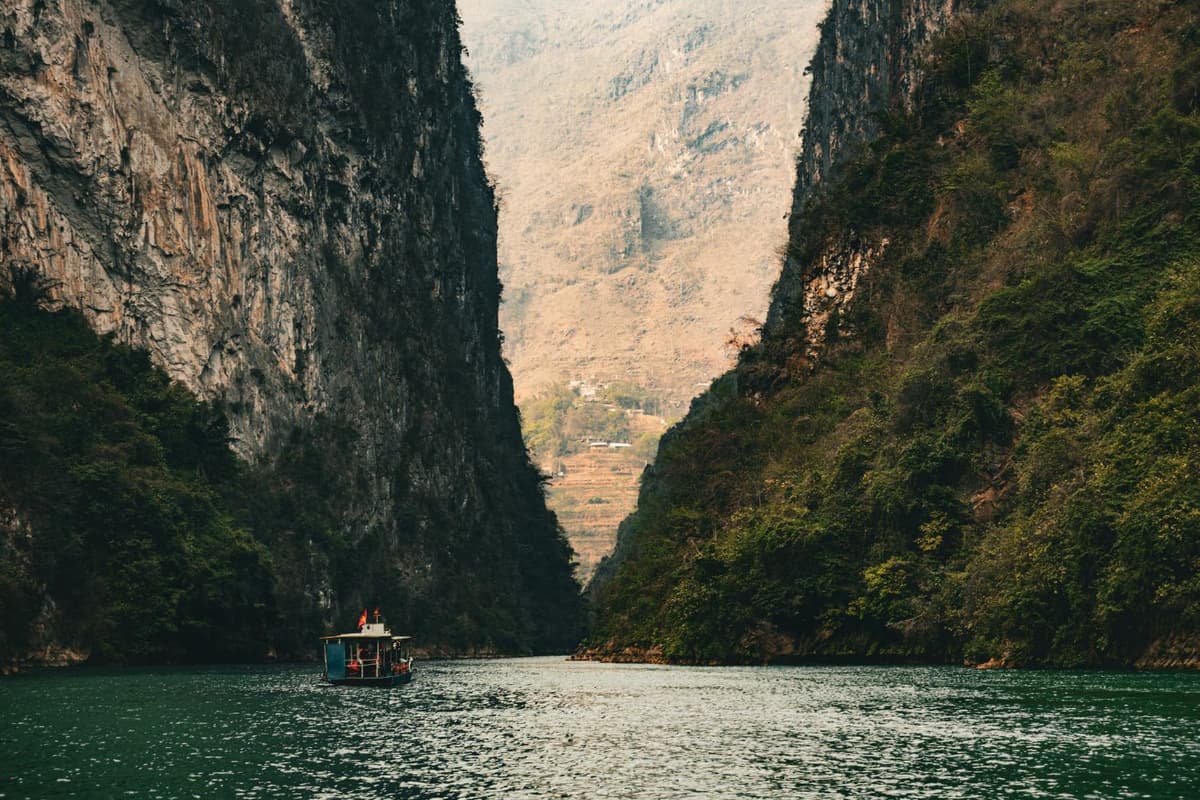
Tu San Canyon, located about 113 km from Lung Khuy Cave, is known as the deepest canyon in Southeast Asia. Its vertical cliffs rise 800–1,000 meters high, and the emerald-green Nho Que River flows gently below. Tourists can take a boat ride from the well-known Tu San dock to admire the breathtaking landscape and towering cliffs. For those who prefer a quieter, more untouched setting, Khau Vai Canyon, about 33 km away, offers the chance to drift on small wooden rafts through shallow waters and narrow rock passages.
On the way to Tu San Canyon, tourists will cross Ma Pi Leng Pass, famous for its breathtaking, picture-perfect scenery. For independent travelers using Google Maps, it’s best to search for “Tu San Canyon Tourism” to reach the parking area and ticket booth.
4. Pa Vi Village:
Pa Vi Hmong Village lies at the foot of Ma Pi Leng Pass, about 7 km from Tu San Canyon. The village stands out with its traditional Hmong architecture. There are earthen-walled houses, tiled roofs, and distinctive stone fences. Pa Vi offers not only the serene beauty of a highland village but also an ideal stop for tourists to experience Hmong life. Along the Ha Giang Loop, visitors can stay in traditional homestays, enjoy local specialties such as five-colored sticky rice and smoked buffalo meat, and learn more about the local culture.
5. Dong Van Karst Plateau Global Geopark:
Dong Van Karst Plateau is about 80 km from Lung Khuy Cave and 38km from Tu San Canyon. This UNESCO Global Geopark is famous for its dramatic limestone peaks and endless stretches of jagged “cat ear” rocks covering the mountains. Along the way, tourists will conquer the scenic Nine-Turn Pass, a highlight for Ha Giang Loop riders, and visit Lung Cam Cultural Tourism Village, home to the film set of The Story of Pao. After admiring the majestic karst landscape and traditional villages from above, tourists can explore Dong Van Old Quarter and the Hmong King’s Palace.
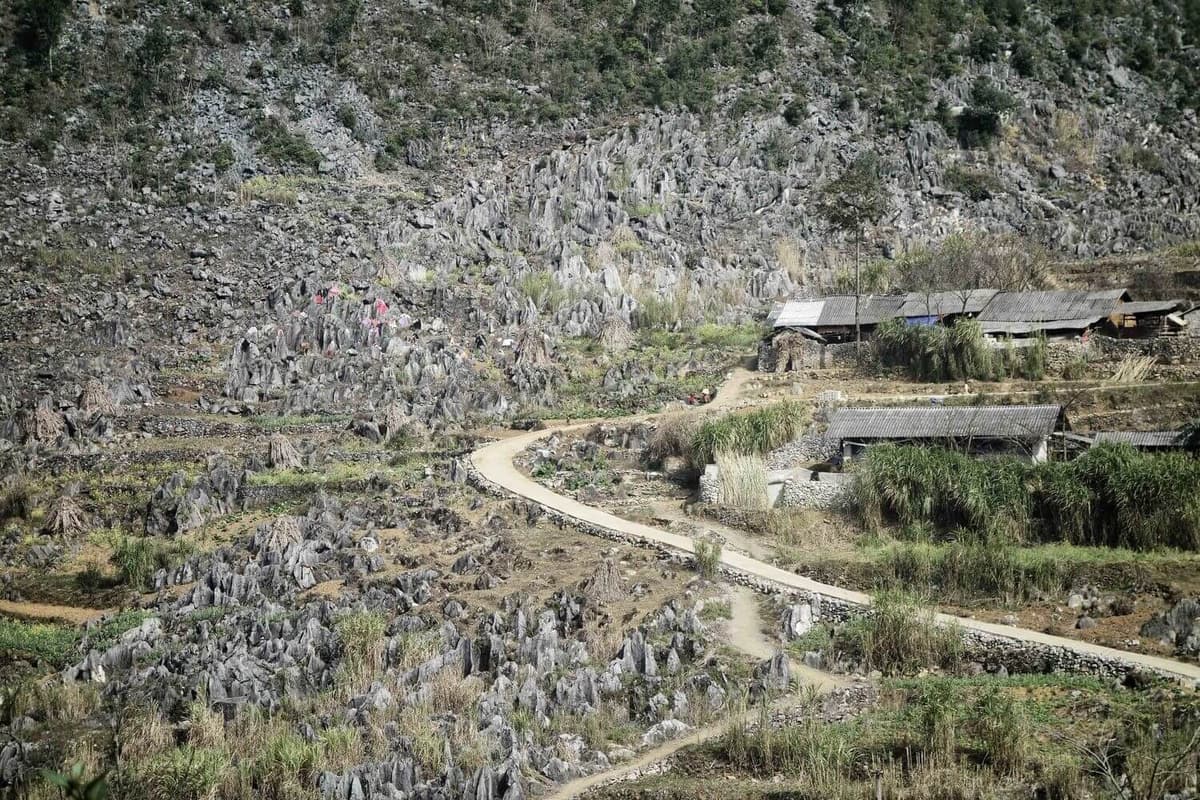
The Dong Van Karst Plateau is recognized as a Global Geopark, featuring strongly weathered limestone formations that create unique landscapes
6. Lung Cu Flag Tower:
Lung Cu Flag Tower is about 110km from Lung Khuy Cave and 28km from the Dong Van Karst Plateau. This iconic check-in spot marks the northernmost point of Vietnam. Tourists can climb around 800 stone steps to reach the tower, where the national flag proudly waves at the country’s frontier. From the top, visitors are rewarded with sweeping views of the Dong Van Karst Plateau and small villages nestled along the mountainsides.
From Lung Cu Flag Tower, tourists can ride about 2km by motorbike to Seo Lung Village, home to Vietnam’s northernmost point. Here, they can enjoy panoramic views of the majestic Northwest and Northeast mountains from the lookout platform and visit the sacred border marker. From the mountaintop, the Vietnam–China border stretches endlessly along the ridgelines, with the emerald Nho Que River winding far below through the canyon.
Suggested 2 day, 1 night Ha Giang Loop itineraries, Including Lung Khuy cave
Day 1: Explore Nature and the Geology of the Karst Plateau
- Morning: Ha Giang city -> Lung Khuy cave -> Nine-Turn Pass -> Lung Cam Village
- Afternoon: Dong Van Karst Plateau -> Dong Van Old Quarter
- Evening: Overnight stay at a homestay in Dong Van Town
Day 2: Enjoy Scenic Landscapes
- Morning: Lung Cu Flag Tower
- Afternoon: Tu San Canyon -> Pa Vi Hmong Village -> Return to Ha Giang City
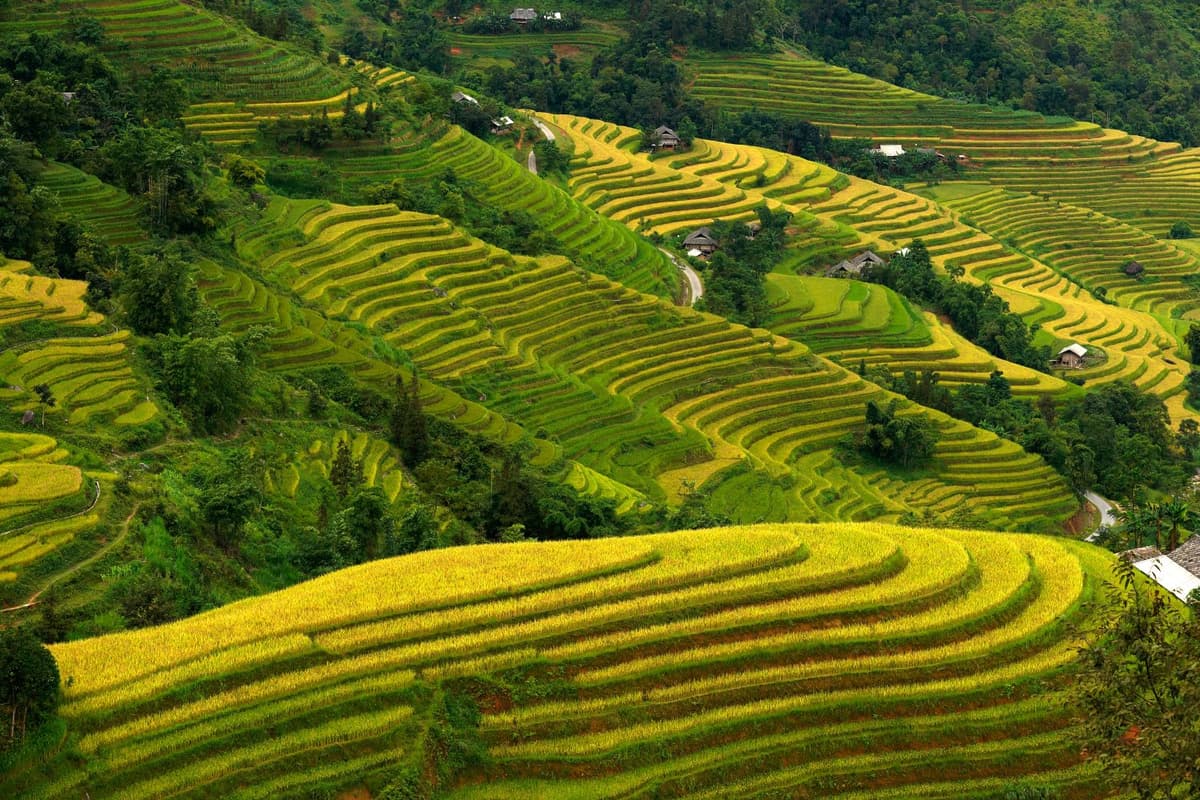
Visiting Lung Khuy Cave combined with traveling the Ha Giang Loop during the ripe rice season (September to November) is one of the most ideal times
In the journey of conquering the breathtaking roads and majestic landscapes of the Ha Giang Loop, Lung Khuy Cave stands out as a highlight, combining remarkable geological formations with mythological legends and the resilient spirit of the Hmong people in the remote highlands. From here, tourists can easily include visits to other famous sites such as Quan Ba Heaven Gate, Dong Van Karst Plateau, and Lung Cu Flag Tower, taking in the full panorama of the region’s natural beauty and highland culture at the northernmost edge of the country.
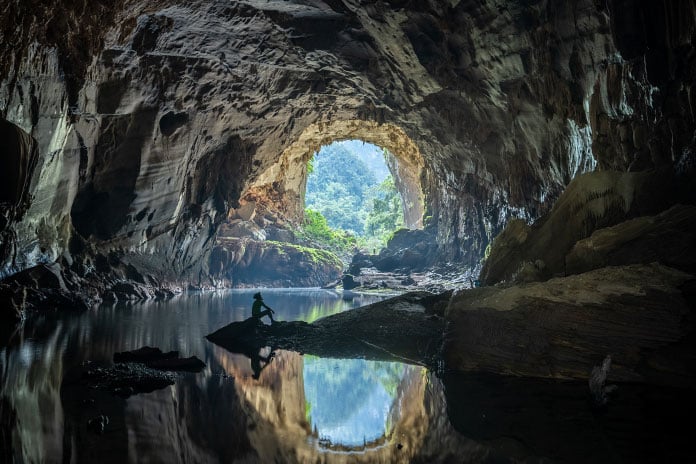
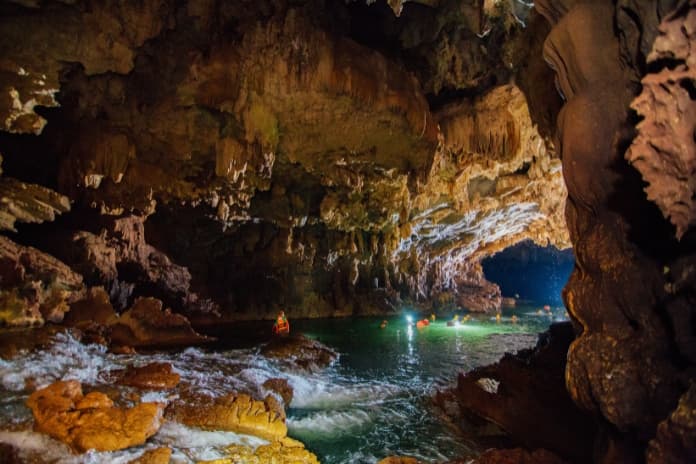
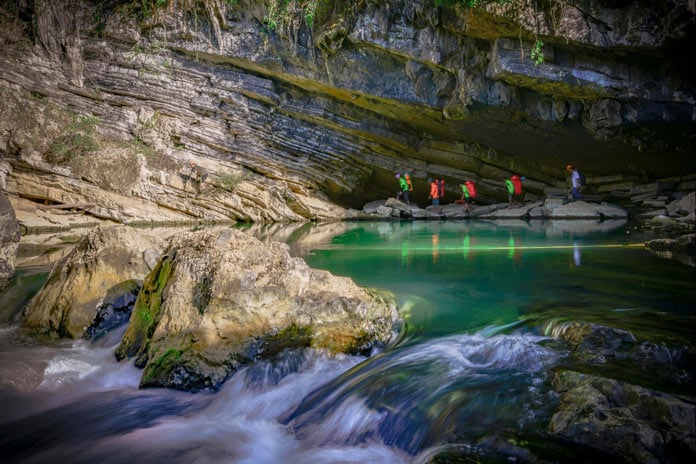
Whether you prefer long treks, camping in a cave, sleeping under the stars in the jungle, swimming underground in river caves, explore the huge dry caves or just taking an exploratory day trip, Oxalis Adventure Tours can provide the right amount of adventure just for you.
__637051782550081035.jpg)
__637051780703588520.jpg)
__637051765075307793.jpg)
__637051774329206026.jpg)
__637740499994967442.jpg)