The Cao Bang Loop: A Different Side of Northern Vietnam
The Ha Giang Loop may be Vietnam's most famous motorbike adventure, attracting thousands of travelers each year with its dramatic mountain passes, towering limestone peaks, and spectacular cliffside roads. But it is not the only unforgettable road trip in northern Vietnam.
Just east of Ha Giang, the Cao Bang Loop takes riders through a completely different landscape of emerald rivers, towering waterfalls, limestone mountains, vast cave systems, and traditional ethnic minority villages.
Set within the UNESCO Non Nuoc Cao Bang Global Geopark along Vietnam's border with China, this route offers some of the country's most impressive natural scenery while remaining far less crowded than many other destinations in northern Vietnam. This guide covers everything you need to plan the perfect Cao Bang Loop, including the best route, motorbike rentals, budgets, accommodation, and essential safety tips.
Why the Cao Bang Loop Deserves a Spot on Your Vietnam Itinerary
The Cao Bang Loop is a great choice for travelers looking for a scenic motorbike adventure without the constant traffic and crowds found on some of Vietnam's more famous routes. The roads are generally well-paved, traffic is light, and daily riding distances can be adjusted to match your experience level and travel style.
One of the biggest advantages of the Cao Bang Loop is its flexibility. You can complete a relaxed 3-day itinerary focused on waterfalls, caves, and valleys, or extend the route to 4 - 5 days to explore remote mountain passes, historical sites, and border regions. The route works equally well for confident self-drivers and travelers who prefer an Easy Rider experience.
Like the Ha Giang Loop, the Cao Bang Loop rewards travelers with spectacular scenery at every turn. The difference is that here you'll find a unique combination of emerald rivers, giant waterfalls, limestone valleys, and authentic local culture all within a relatively compact area.
Ride Through a UNESCO Global Geopark
The entire route winds through the UNESCO Non Nuoc Cao Bang Global Geopark, home to limestone formations dating back 400 - 500 million years. Along the way, you'll ride past lush valleys, karst mountains, caves, rivers, and geological sites that tell the story of the region's ancient past.
See One of Asia's Most Beautiful Waterfalls
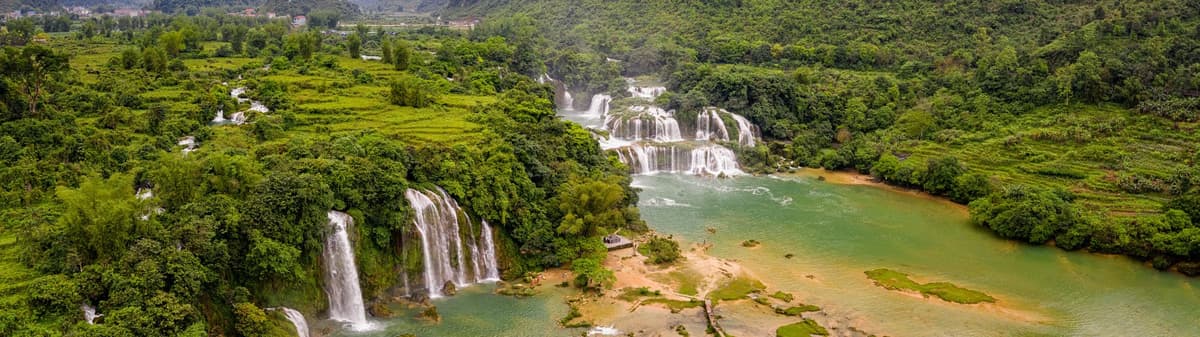
Visiting Ban Gioc Waterfall is widely considered the best thing to do in Cao Bang. The waterfall is the largest in Vietnam and one of the world's most spectacular border waterfalls. Stretching nearly 300 meters wide, it cascades over multiple limestone tiers surrounded by lush forest, creating one of the most iconic natural landscapes in Southeast Asia.
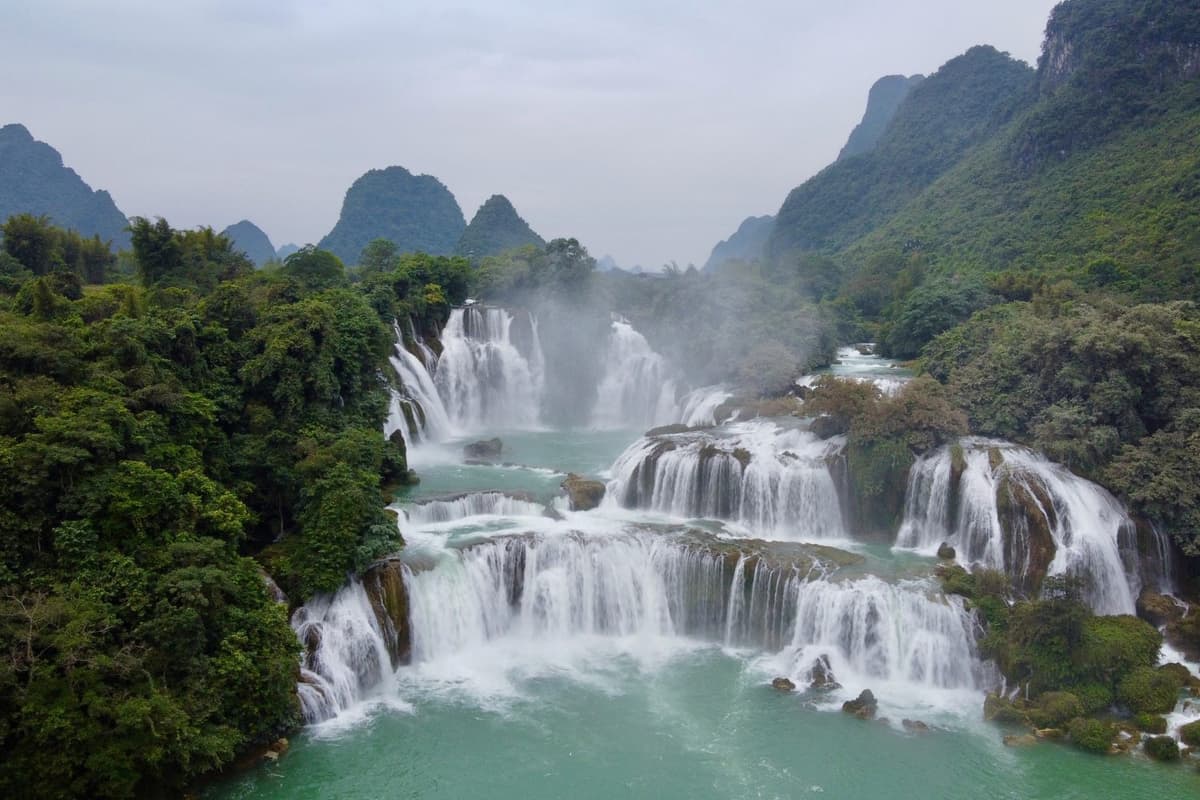
Ban Gioc stands out as one of the most stunning waterfalls in Asia.
Experience Authentic Local Culture
Because tourism remains relatively low-key, encounters with local communities often feel genuine and unfiltered. You'll pass through villages inhabited by Tay, Nung, Hmong, and Lo Lo ethnic groups, where daily life continues much as it has for generations. Traditional craft villages such as Phuc Sen still preserve centuries-old blacksmithing techniques, offering a glimpse into local culture that extends far beyond tourism.
Best Time to Ride the Cao Bang Loop, Vietnam
The best time to ride the Cao Bang Loop is from September to November and March to April. During these months, the weather is generally dry, road conditions are safer for motorbike travel, and scenic highlights such as Ban Gioc Waterfall remain impressive. September and October are particularly rewarding, as the rice fields in the Phong Nam Valley turn brilliant golden yellow, creating some of the most beautiful landscapes in northern Vietnam.
From June to August, Ban Gioc Waterfall reaches its most powerful and dramatic state, with massive volumes of white water cascading over the falls. However, this is also the rainy season in Cao Bang. Riders should be prepared for heavy rainfall, slippery roads, muddy sections, and occasional landslides, especially on mountain routes.
Regardless of the season, the best time to visit Ban Gioc Waterfall is between 10:30 AM and 1:00 PM, when an upstream hydroelectric dam releases water, increasing the waterfall's flow to its peak level. For photography, arrive before 10:00 AM to enjoy the soft morning light and fewer visitors.
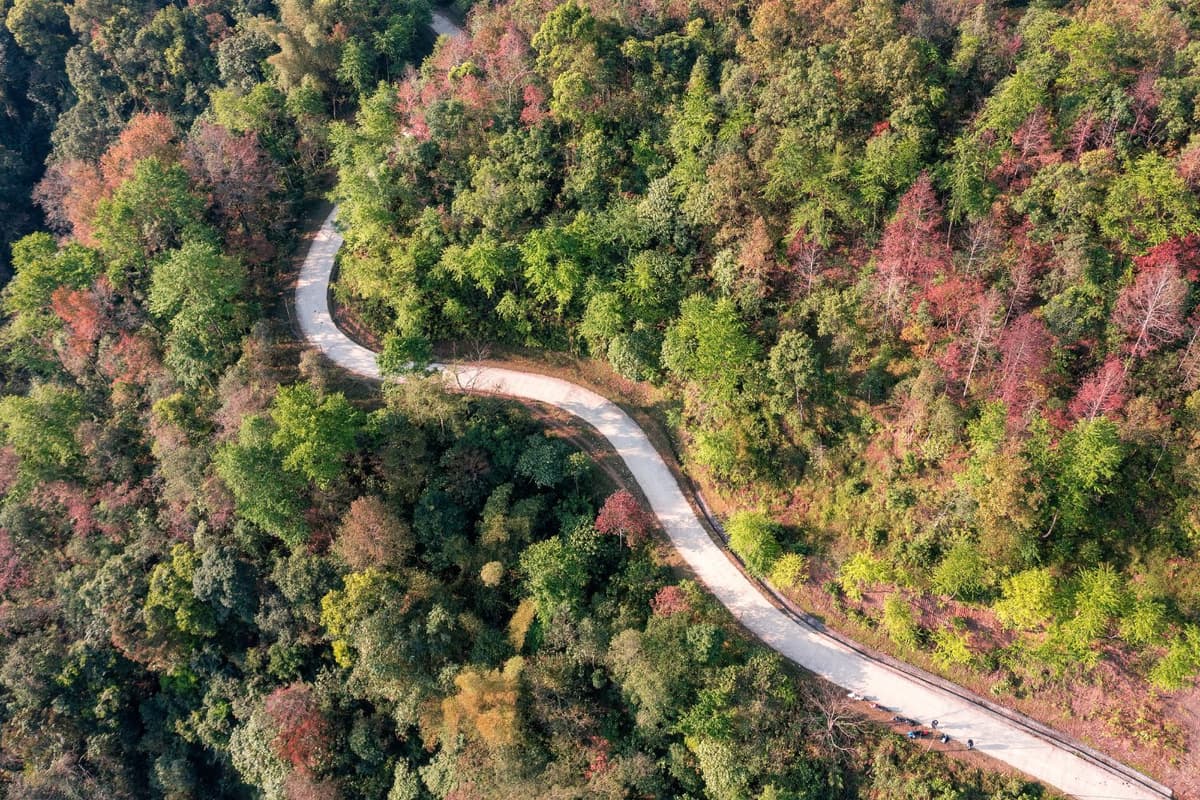
The road to Ban Gioc passes Ban Viet’s vibrant red maple trees.
How to Get to Cao Bang, Motorbike Rental and Easy Riders
Getting to Cao Bang City
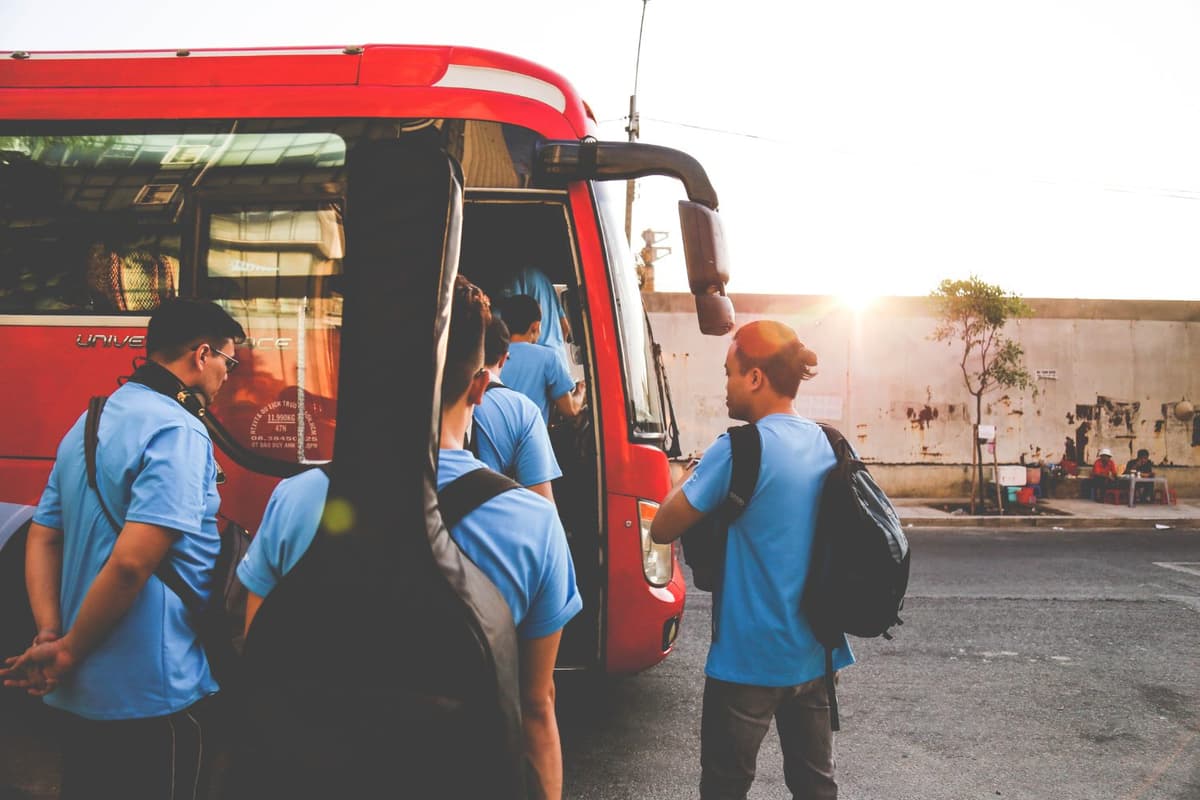
Most travelers begin their Cao Bang Loop adventure by taking an overnight sleeper bus from Hanoi. Buses depart from My Dinh and Gia Lam bus stations between 8:00 PM and 9:00 PM, arriving in Cao Bang City between 5:00 AM and 7:00 AM the following morning.
Expect to pay around 400,000 - 700,000 VND ($16 - 28 USD) depending on the bus operator, seat type, and travel season. Taking a night bus allows you to maximize your time on the loop while saving on accommodation costs.
Choosing Your Ride (Self-Drive vs. Easy Rider)
The Cao Bang Loop can be explored either independently by motorbike or with an experienced local driver.
Self-Drive
Self-driving is best suited for riders with solid motorbike experience, especially on mountain roads. For those planning to tackle steep passes and varied terrain, the Honda XR150L is one of the most popular choices, typically costing around 500,000 VND per day.
If you plan to stay mainly on paved roads, a Honda Air Blade (around 300,000 VND per day) or a semi-automatic Honda Future (around 200,000 VND per day) is usually sufficient.
Popular rental providers include Green Riders, which offers shower facilities for guests arriving on early buses, and PIA Homestay, a well-known base among loop riders.
Easy Rider
If you do not have an International Driving Permit (IDP), lack experience riding motorbikes, or simply want to focus on the scenery, an Easy Rider tour is an excellent option.
Your local driver handles the navigation and mountain roads while you relax, take photos, and enjoy the journey. Most 3-day Cao Bang Loop Easy Rider tours cost between $180 - 220 USD, depending on the itinerary and inclusions.
Tips: Avoid carrying large suitcases on a motorbike. Most rental shops and homestays in Cao Bang City offer secure luggage storage, allowing you to leave your main bag behind. Instead, pack only the essentials in a 15 - 20 liter backpack, place it inside a waterproof cover or dry bag, and secure it firmly to the back of the bike.
The Perfect 3-Day Cao Bang Loop Itinerary (Moderate Pace)
This 3-day Cao Bang Loop itinerary is designed for travelers who prefer a relaxed pace and plenty of time to enjoy the journey. The standard Cao Bang Loop covers roughly 200 - 250 km and can comfortably be completed in 3 days, making it ideal for first-time visitors and riders who want plenty of time for sightseeing. The route forms a compact loop in eastern Cao Bang, with major highlights such as Ban Gioc Waterfall, Nguom Ngao Cave, and Angel Eye Mountain (Thung Mountain) located relatively close to one another.
Daily riding distances are short, allowing you to stop whenever you like for photos, coffee breaks, or simply to admire the scenery without worrying about reaching your destination before dark. It is an ideal option for first-time loop riders, couples, and anyone looking for a safer, more laid-back motorbike adventure.
Here is the Cao Bang Loop map. If you have additional time and want to explore more remote landscapes, alternative routes and extended itineraries are covered in the next section.
Day 0: Hanoi to Cao Bang City
To maximize your time on the Cao Bang Loop, leave Hanoi the night before. Most sleeper buses depart between 8:00 PM and 9:00 PM, arriving at Cao Bang City Bus Station between 5:00 AM and 7:00 AM the following morning after a 7 - 10 hour journey.
One of the nice things about riding the Cao Bang Loop is that you don't need to book an extra hotel room upon arrival. Many reputable rental shops and homestays, including Green Riders, PIA Homestay, and Cao Bang Motorbike For Rent, allow overnight bus passengers to shower, freshen up, and rest for a few hours before collecting their bikes.
If your budget allows, consider upgrading to a VIP cabin bus. The extra privacy and comfort make a noticeable difference, especially before several days on the road. Taking a night bus also saves the cost of one night's accommodation.
While waiting for your bike, head out for breakfast and try Cao Bang's famous banh cuon. Unlike elsewhere in Vietnam, the delicate rice rolls are served with a bowl of hot bone broth rather than fish sauce. Another local favorite is pho chua, a refreshing sweet-and-sour noodle dish that is surprisingly addictive.
Day 1: Cao Bang City - Tra Linh - Ban Gioc Waterfall (~104km)
After collecting your motorbike (or meeting your Easy Rider driver) between 8:00 AM and 8:30 AM, you'll receive a safety briefing, rain gear, and basic riding instructions. By 9:00 AM, it's time to hit the road.
The first day is one of the most scenic sections of the entire Cao Bang Loop. The route winds through a landscape of limestone peaks, rice fields, and traditional villages before reaching Ma Phuc Pass, one of Cao Bang's most iconic mountain roads. The pass twists through towering karst formations and offers sweeping views of the surrounding countryside.
Continue toward the Ngoc Con and Phong Nam valleys, where the emerald-green Quay Son River snakes through fields and villages beneath dramatic limestone mountains. This is the kind of landscape that makes riders stop every few kilometers just to take another photo.
Afternoon: Ban Gioc Waterfall and Truc Lam Phat Tich Pagoda
By afternoon, you'll arrive at Ban Gioc Waterfall, the largest waterfall in Vietnam and one of the most spectacular border waterfalls in the world.
Stretching nearly 300 meters wide, the waterfall spills over multiple limestone terraces into the emerald waters of the Quay Son River. Surrounded by towering karst mountains and dense greenery, the landscape feels almost unreal. Locally, Ban Gioc is sometimes called the "Waterfall of Nine Levels" because of its series of cascading tiers. Depending on the season, the water can appear crystal turquoise or transform into a roaring wall of white water after summer rains.
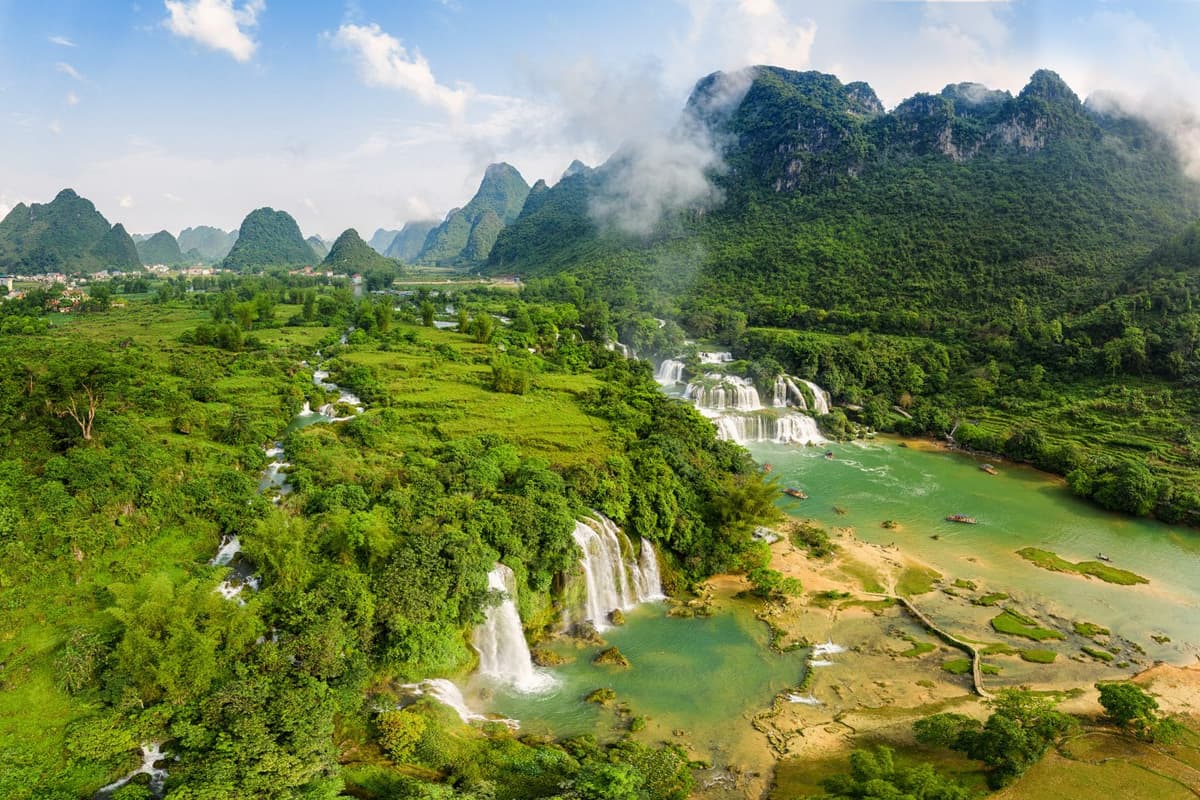
Locally referred to as the "Waterfall of Nine Levels," the water drops in a series of powerful, cascading tiers.
For the most memorable experience, take a bamboo raft to the base of the falls. As the raft approaches the main cascade, you'll feel the spray on your face and hear the thunder of the water echoing through the valley. Tickets cost around 50,000 VND per person, although some operators may initially quote higher prices. After the boat ride, follow the riverside walkway for additional viewpoints and a close look at the Vietnam - China border.
Before sunset, ride up to Truc Lam Phat Tich Pagoda, which sits on a hillside overlooking Ban Gioc Waterfall. The viewpoint offers a sweeping panorama of the waterfall, the Quay Son River, and the limestone mountains stretching into the distance. As the afternoon sun begins to drop, the entire valley takes on a warm golden glow, making this one of the best photo spots on the Cao Bang Loop.
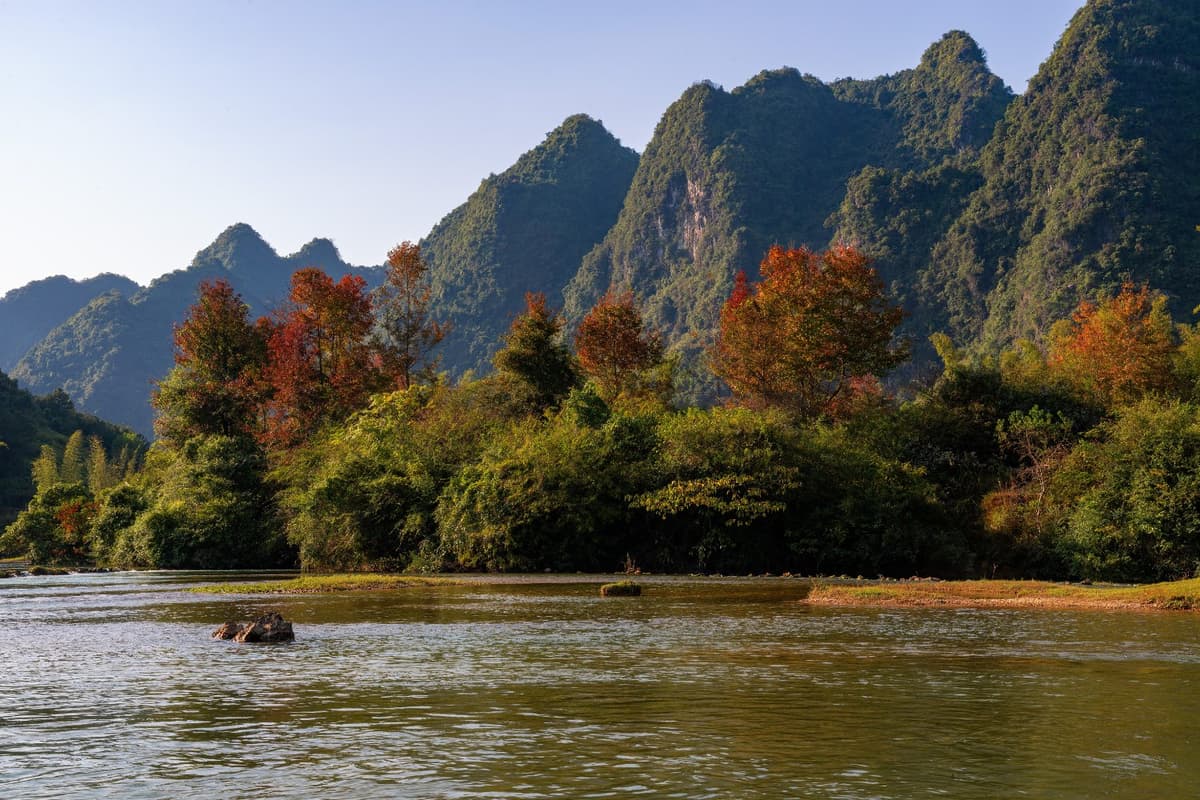
Golden hour brings peace to the red-leafed banks of Quay Son river.
A useful local tip: you can ride your motorbike all the way to the pagoda entrance and park for free. Ignore anyone at the bottom of the hill who claims you must pay for parking and walk the rest of the way.
Overnight: Khuoi Ky Stone Village
Spend the night in Khuoi Ky Stone Village, a charming Tay ethnic village with a history spanning more than 400 years. Known for its unique stone stilt houses and stone walls built according to traditional Tay beliefs, the village offers one of the most atmospheric stays on the Cao Bang Loop. Surrounded by limestone mountains and gentle streams, it feels worlds away from modern city life.
As evening falls, the village becomes wonderfully quiet. Enjoy a Cao Bang home-cooked dinner featuring local specialties such as smoked sausage, dried buffalo meat, crispy stream fish, or black olive sticky rice. Then relax to the sound of the nearby stream and prepare for another day of exploration.
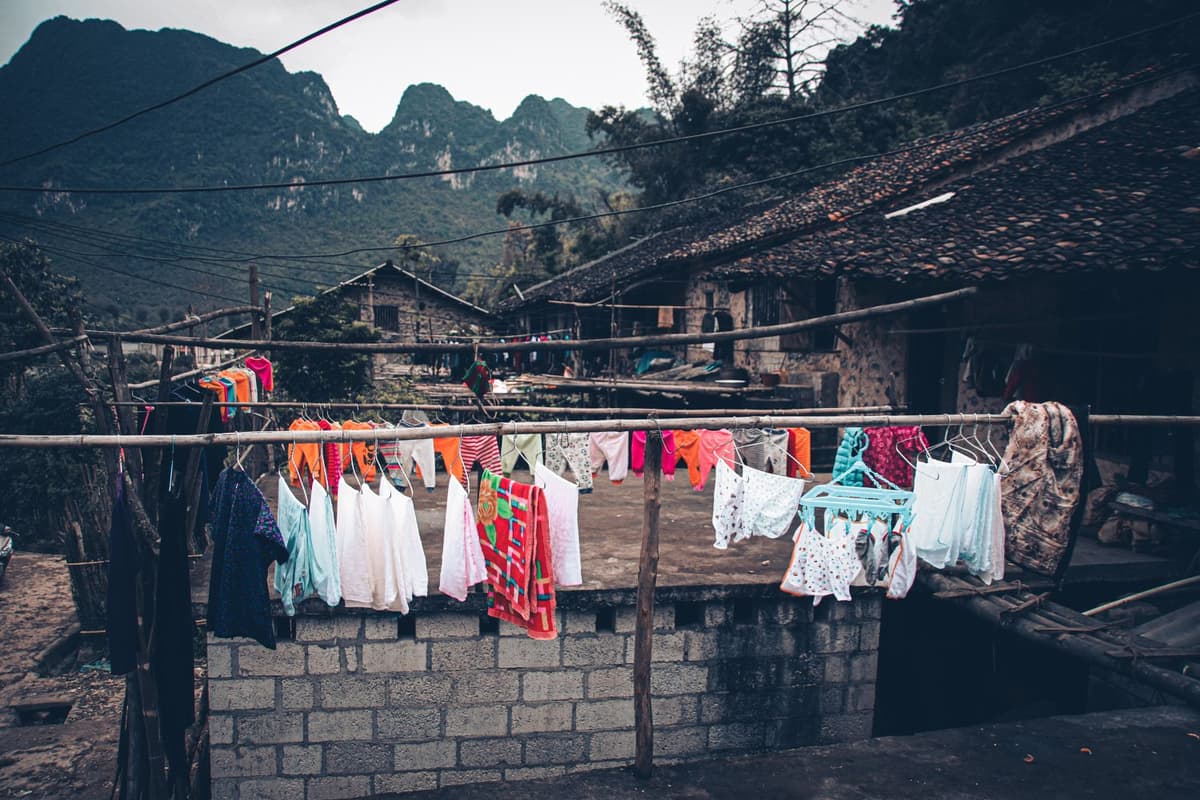
Your first night on the Cao Bang Loop will be spent in the historic Khuoi Ky Stone Village.
Day 2: Ban Gioc - Nguom Ngao Cave - Phuc Sen Village - Quang Uyen (~63km)
Morning: Explore Nguom Ngao Cave and Quay Son water wheels
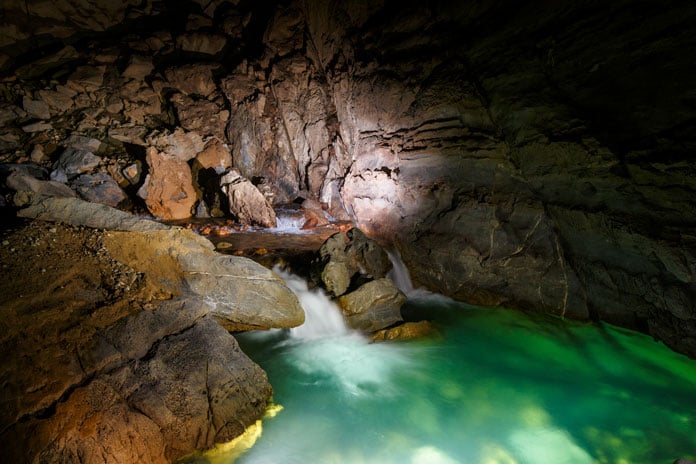
Start the day with a visit to Nguom Ngao Cave, often considered one of the most impressive caves in northern Vietnam. The name translates to "Tiger Cave" in the local Tay language, and once inside, it's easy to see why this place leaves such a strong impression on visitors.
The tourist route stretches for about 1km, winding through enormous chambers filled with thousands of limestone formations shaped over millions of years. Massive columns rise from floor to ceiling like natural cathedrals, while soft lighting highlights the cave's intricate textures and colors. Unlike many cave attractions, you can explore the open section independently. Despite what some touts may claim outside the entrance, hiring a guide is not required.
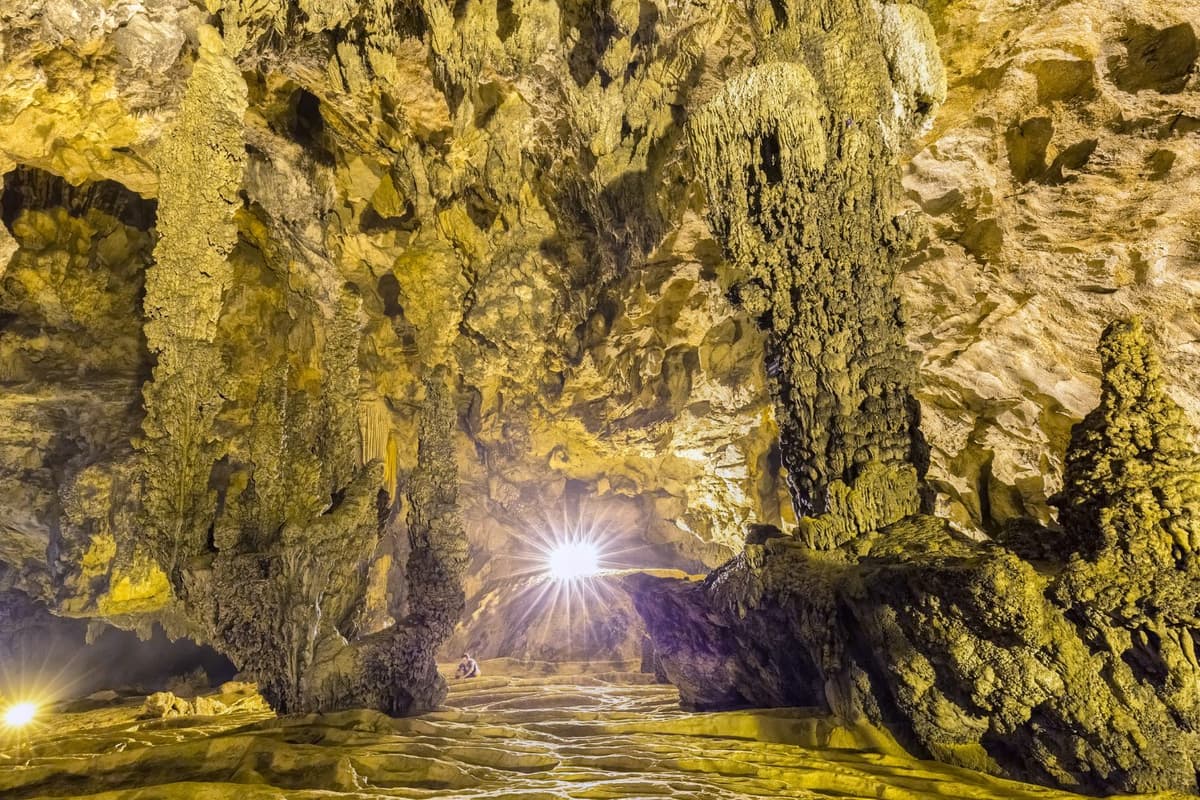
Soft, artful lighting inside the cave highlights the intricate textures and unique colors of the stalactites and stalagmites.
Afterward, take a scenic ride along the Quay Son River. The peaceful river valleys here are dotted with giant wooden water wheels, some standing several meters tall. These traditional irrigation systems continue to carry water from streams into rice fields, creating one of the most iconic rural scenes in Cao Bang. Before leaving Trung Khanh, grab a bag of freshly roasted Trung Khanh chestnuts - the perfect snack for the road ahead.
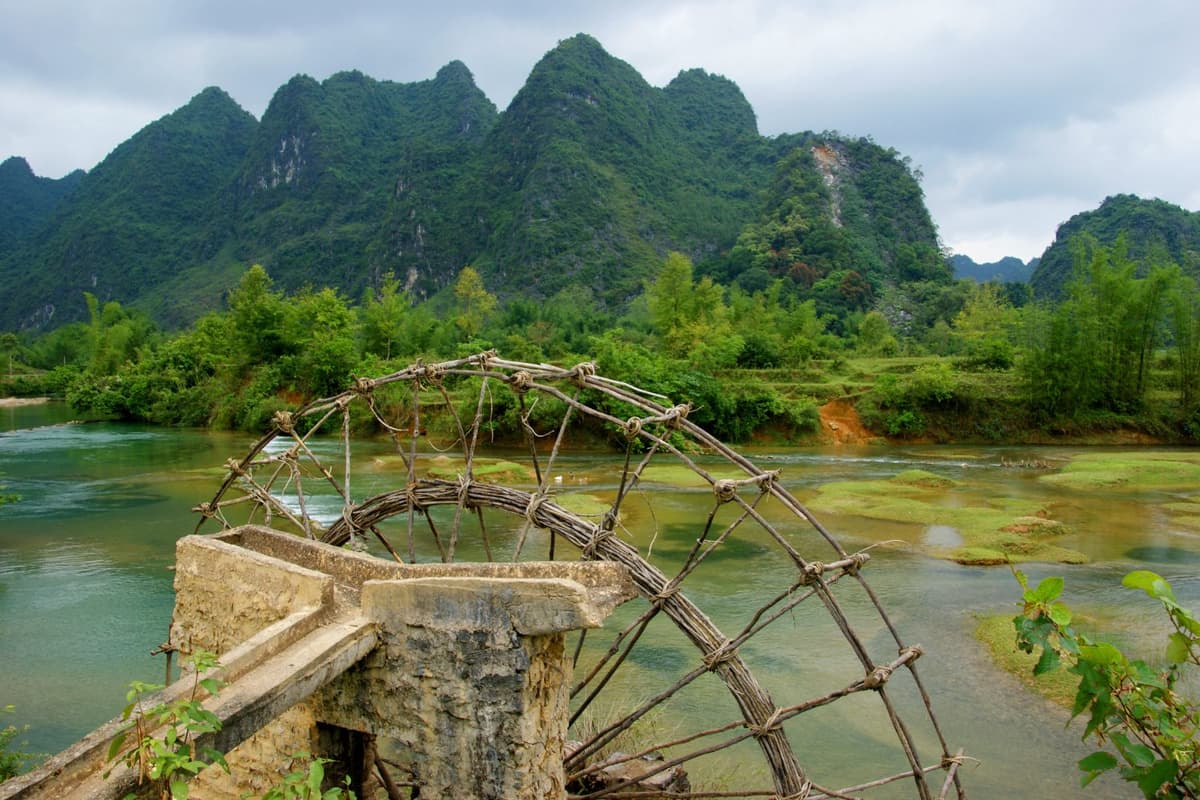
The giant wooden water wheels along the Quay Son River are an iconic symbol of rural Cao Bang.
Lunch: Cao Bang's signature roast duck
For lunch, stop at a local restaurant and order 7-flavor roasted duck, one of Cao Bang's most beloved specialties. The duck is marinated with forest honey, mac mat leaves, and a blend of local herbs and spices before being roasted until the skin becomes crispy and golden. The result is a dish that's smoky, fragrant, and unlike roast duck found elsewhere in Vietnam.
Afternoon: Traditional craft valleys
The afternoon ride takes you towards Quang Uyen district. Continue to Phuc Sen Village, home to generations of Nung blacksmiths. The rhythmic sound of hammering echoes through the village as artisans forge knives using techniques passed down for centuries. If you're looking for a practical souvenir, a handmade kitchen knife typically costs between 200,000 - 500,000 VND.
As you approach your homestay, keep an eye out for vendors selling Cao Bang Che Lam, a chewy local sweet made from glutinous rice, forest honey, and peanuts. It makes an excellent dessert or gift to take home.
Evening: Homestay dinner in Quang Uyen
Spend the night at a homestay in Quang Uyen. For dinner, join the host family's evening meal if possible. This is often one of the most memorable experiences on the Cao Bang Loop. Ask if they can prepare local specialties such as smoked lap xuong sausage, flavored with mac mat leaves and slowly cured above the kitchen fire, or fermented sour pork, a regional dish traditionally preserved in bamboo tubes.
Day 3: Quang Uyen - Angel Eye Mountain - Cao Bang City (~54 km)
Morning: Angel Eye Mountain and the Nam Tra Valley
Your final day begins with one of the most unique landscapes on the entire Cao Bang Loop. Leaving Quang Uyen behind, you'll ride into the quiet Nam Tra Valley, home to Angel Eye Mountain (Nui Thung). Rising from a sea of grassland, the mountain is instantly recognizable thanks to the enormous circular hole that pierces straight through its summit. Measuring roughly 35 - 50 meters in diameter, this natural "eye" was carved by millions of years of geological activity and has become one of the most photographed landmarks in Cao Bang.
What makes the area special, however, is not just the mountain itself. The entire valley feels wonderfully isolated. Vast meadows stretch between limestone peaks, small ponds reflect the surrounding cliffs, and grazing horses, buffalo, and cattle wander freely across the landscape. On a quiet morning, the only sounds are birdsong and the wind moving through the grass.
The scenery changes dramatically throughout the year. During the dry season, the valley becomes a sweeping green prairie. In the rainy season, parts of the grassland transform into shallow lakes, creating mirror-like reflections of the surrounding karst mountains. Take your time here. This isn't a place to rush through. It's a place to sit, walk, and simply enjoy the silence.
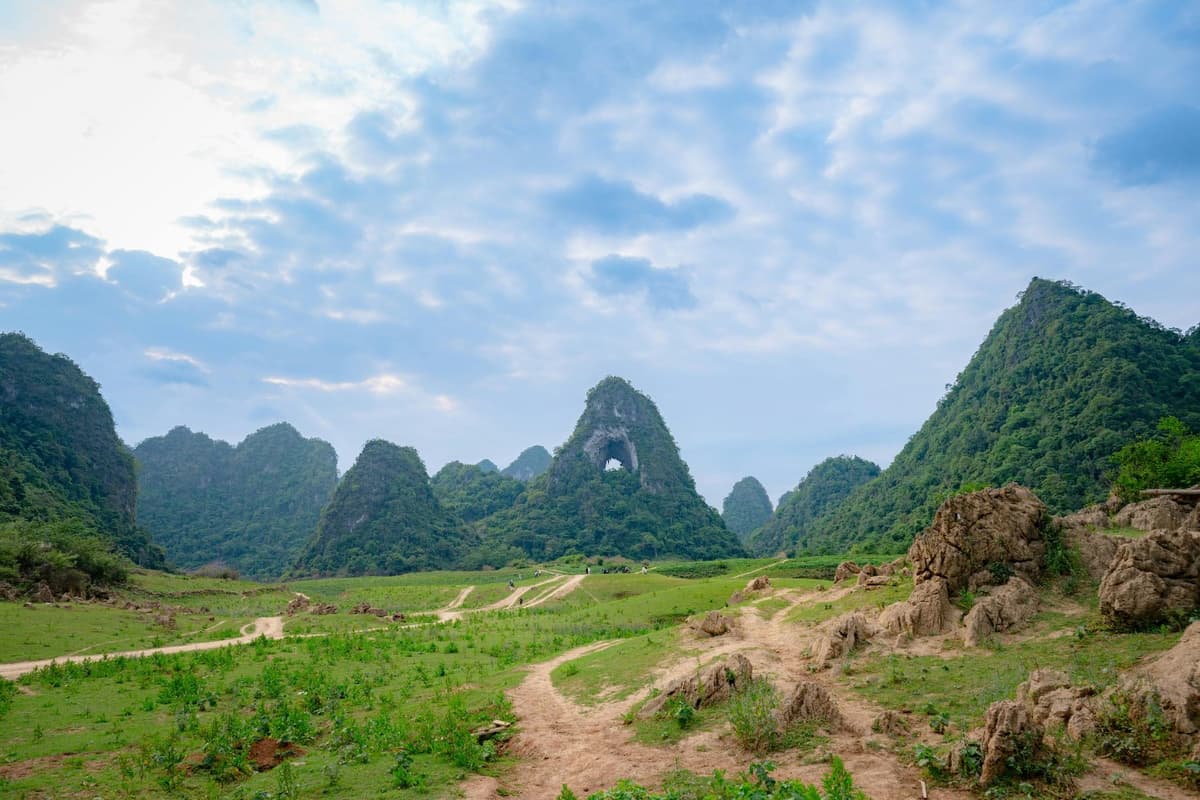
Angel Eye Mountain, or Nui Thung, is one of the most unique and recognizable natural landmarks on the entire Cao Bang Loop.
Midday: Thang Hen Lake
Before returning to Cao Bang City, make a detour to Thang Hen Lake, a collection of interconnected lakes hidden among limestone mountains and dense forest.
Unlike the dramatic scenery of Ban Gioc Waterfall, Thang Hen's beauty is subtle. Calm turquoise water, overhanging trees, and quiet mountain reflections create a peaceful atmosphere that feels worlds away from Vietnam's busier tourist destinations. It's the perfect final stop before heading back to town.
Afternoon: One last taste of Cao Bang
Arriving back in Cao Bang City, you'll have time for one final meal before ending the loop. A bowl of Cao Bang Pho Chua is a great choice after several days on the road. The dish combines chewy rice noodles with roast duck sauce, pickled vegetables, peanuts, fresh herbs, and crispy shallots, creating a balance of sweet, sour, savory, and crunchy flavors unlike any other pho in Vietnam.
Spend the rest of the afternoon wandering the city, enjoying a Vietnamese coffee, or simply reflecting on the journey before returning your motorbike.
In the late afternoon, return to your rental shop and hand back the bike. Most rental providers offer complimentary shower facilities, allowing you to clean up and change clothes before your overnight journey. Sleeper buses for Hanoi typically depart between 8:00 PM and 9:00 PM. Settle into your cabin, watch the lights of Cao Bang disappear into the distance, and enjoy a well-earned rest.
For Experienced Riders: The Ultimate 4-Day Cao Bang Loop
If you have an extra day and enjoy longer rides, remote border roads, and a bit more adventure, consider extending your trip into a 4-day Cao Bang Loop. The biggest additions are Pac Bo Historical Site and Me Pia Pass (Khau Coc Cha Pass), two destinations that showcase a completely different side of Cao Bang.
Instead of heading east toward Ban Gioc Waterfall on Day 1, you'll first ride northwest toward the Chinese border.
Stop 1: Pac Bo Historical Site
Your first major stop is Pac Bo, a historically important site surrounded by some surprisingly beautiful scenery. The highlight is Lenin Stream, a crystal-clear river famous for its vivid emerald-blue water flowing beneath limestone cliffs and forest-covered mountains.
The peaceful setting feels more like a nature reserve than a historical monument. Early in the morning, the reflections on the water can be spectacular, making it one of the most photogenic stops on the entire loop.
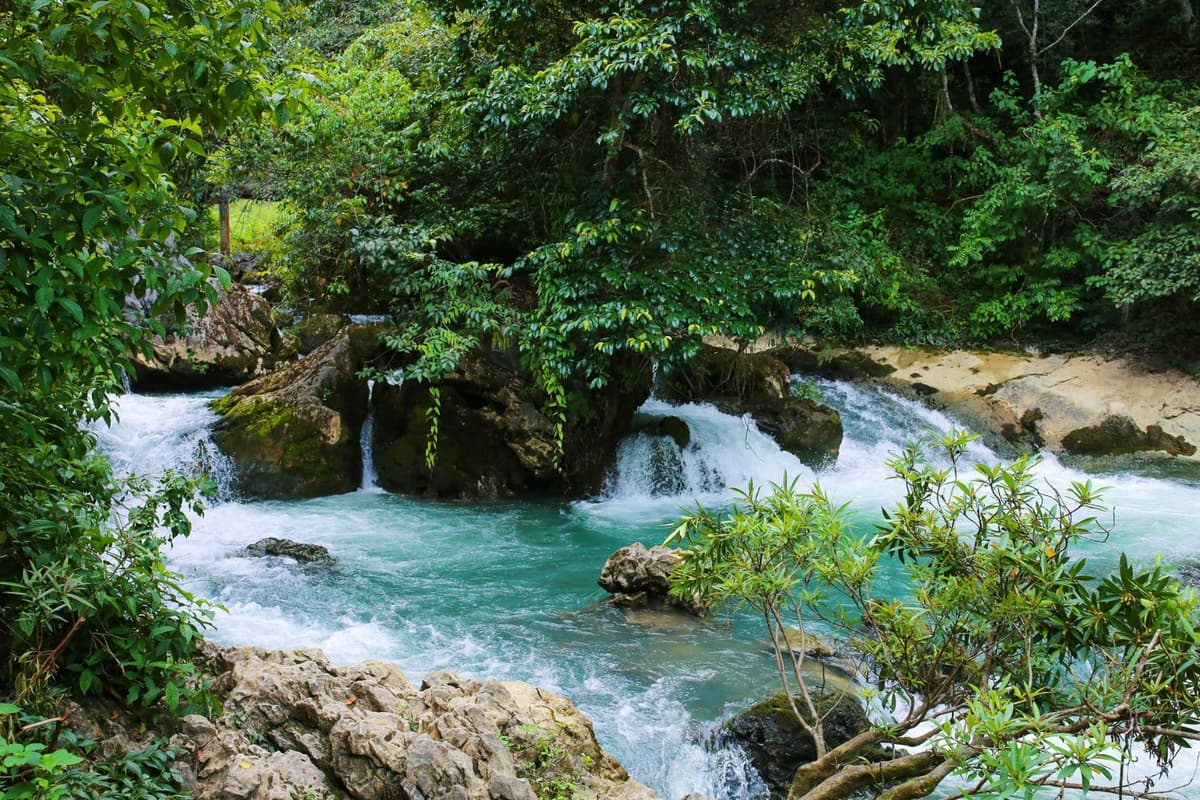
The vibrant color of the Lenin stream sets against the dense forest.
Stop 2: Me Pia Pass (Khau Coc Cha Pass)
From Pac Bo, continue along remote border roads toward Bao Lac District, home to the legendary Me Pia Pass.
The pass is famous for its 14 tightly stacked hairpin bends, carved dramatically into the mountainside. Viewed from above, the road twists back and forth like a giant ribbon climbing the cliff face, creating one of the most impressive road scenes in northern Vietnam.
After exploring the area, spend the night in Bao Lac before continuing eastward the following day to reconnect with the standard 3-day route toward Ban Gioc Waterfall.
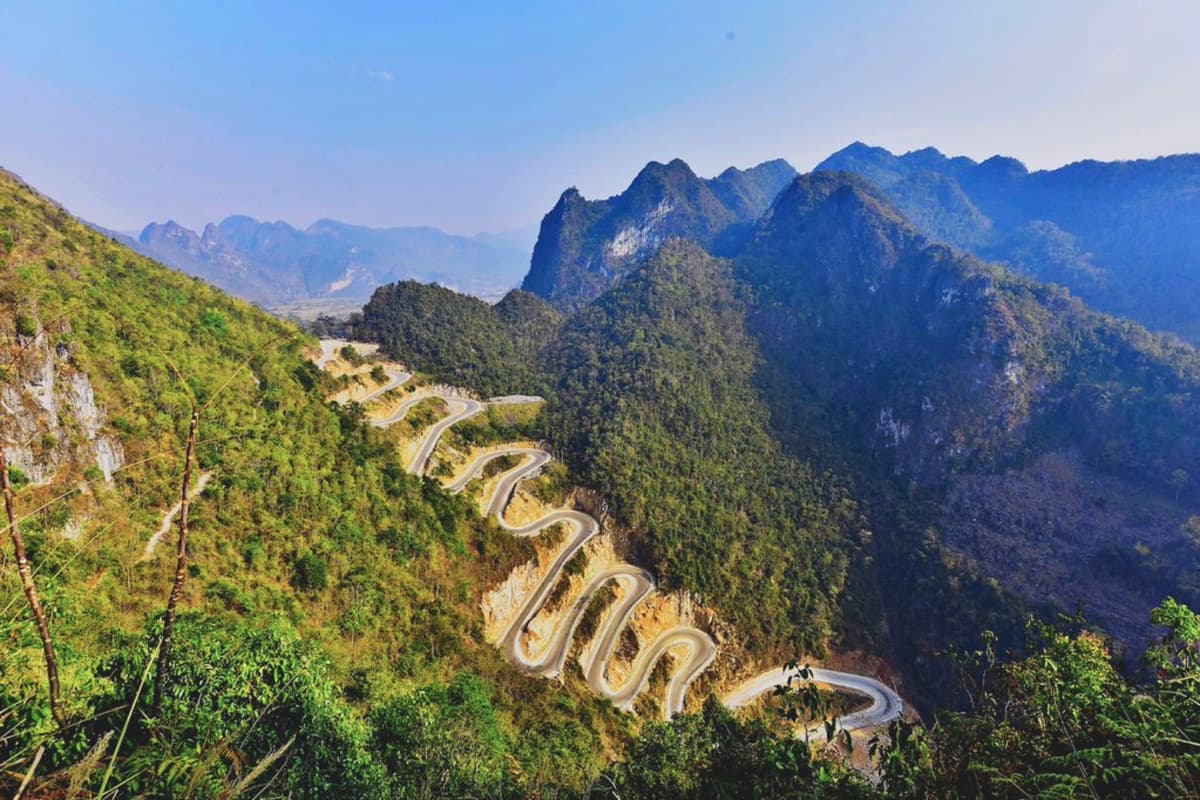
Khau Coc Cha is legendary for its 14 tightly stacked hairpin bends carved directly into the mountainside.
Important reality check about Me Pia Pass
Many travelers arrive expecting to enjoy the famous viewpoint directly from their motorbike. In reality, that's not possible. While riding the pass, you'll only see the next corner ahead of you. The iconic panoramic view of all 14 switchbacks can only be seen from a viewpoint above the road.
To reach it, head to the small refreshment shop run by Mr. Nong Van Ngoan near the top of the pass. Leave your bike there and follow the forest trail uphill. The round-trip hike takes roughly one hour, including both the ascent and descent. Parts of the trail are steep, uneven, and can become slippery after rain, so proper footwear with good grip is essential.
The effort is well worth it. From the viewpoint, the entire pass unfolds beneath you in a series of dramatic curves, offering one of the most rewarding panoramas anywhere on the Cao Bang Loop.
Breaking Down the Cost of the Cao Bang Loop
One of the best things about the Cao Bang Loop is how affordable it remains compared to many other motorbike adventures in Southeast Asia. Even with comfortable accommodation, good food, and a few activities along the way, costs stay surprisingly reasonable.
Budget traveler (Self-drive)
Travelers renting their own motorbike, staying in dormitory-style accommodation, and eating at local restaurants can expect to spend around $170 USD for a 3-day loop. (excluding round-trip bus tickets from Hanoi, around $32 USD).
Mid-range traveler (Easy rider)
For those who prefer an Easy Rider experience, private rooms, VIP sleeper buses, and more comfortable travel arrangements, the budget typically comes to around $350 USD. It includes Easy Rider services, accommodation, transportation, meals, and tips.
Typical travel costs
- Ban Gioc waterfall entrance fee: 50,000 VND (~$2 USD)
- Nguom Ngao cave entrance fee: 45,000 VND (~$2 USD)
- Local meals: 30,000 - 60,000 VND ($1 - 2.50 USD)
- Tourist-area restaurants: 80,000 - 150,000 VND ($3 - 6 USD)
- Dorm bed: 150,000 - 250,000 VND ($6 - 10 USD)
- Private homestay room: 250,000 - 300,000 VND ($10 - 13 USD)
A small daily budget goes a long way in Cao Bang. Many of the region's best experiences, riding through river valleys, exploring mountain villages, or watching sunset over limestone peaks, cost nothing at all
Crucial Safety and Insider Tips (Read Before You Ride)
- Do not fly a drone at Ban Gioc Waterfall. The waterfall sits directly on the Vietnam - China border. Drones can be confiscated, and authorities may intervene immediately.
- Carry a valid International Driving Permit (IDP 1968). Traffic police checks are generally less frequent than on some northern Vietnam routes, but riding without a valid license can void your travel insurance.
- Choose an Easy Rider if you're not confident on mountain roads. It's safer, less stressful, and allows you to focus on the scenery.
- Download offline maps before leaving Cao Bang City. Mobile signals disappear in many valleys and mountain sections. Maps.me is often more reliable than Google Maps on smaller rural roads.
- Never rely entirely on mobile data or GPS. Save your accommodation addresses and key waypoints offline.
- Use engine braking on steep descents. Shift into a lower gear instead of continuously squeezing the brakes, which can cause brake fade or overheating.
- Watch for buffalo, cows, and other livestock. Animals often wander onto the road, especially around blind corners and village areas.
- Ride slower after rain. Mud, gravel, and wet concrete can become surprisingly slippery. Avoid riding after dark. Roads are poorly lit, animals become harder to spot, and mountain fog can significantly reduce visibility.
- Fuel is readily available in Cao Bang City, Tra Linh, Trung Khanh, and Quang Uyen. Major petrol stations operate from early morning until around 10:00 PM, but official stations become much less common once you enter remote valleys and mountain roads.
- Refuel whenever you pass a major town. Even if your tank is half full, top it up before heading toward places like Angel Eye Mountain, Phong Nam Valley, Ngoc Con Valley, or Ba Quang Grass Hill. Aim to keep at least two-thirds of a tank before entering remote areas.
- Start early each morning. The best weather, lighting, and road conditions are usually before noon.
- Carry cash. Many homestays, restaurants, and small shops do not accept cards.
Final Thoughts
Planning a motorbike adventure in northern Vietnam? The Cao Bang Loop offers an unforgettable mix of waterfalls, caves, valleys, and authentic local culture. Save this guide, download your offline maps, and start planning one of Vietnam's most rewarding road trips.
If you're interested in another unforgettable motorbike adventure that combines spectacular scenery with Vietnam's wartime history, consider adding the Khe Sanh Route to your bucket list. Connecting Phong Nha and Khe Sanh, this route takes you through the legendary Ho Chi Minh Trail, remote mountain landscapes, former battlefields, and historic sites that played a major role during the war.
Frequently Asked Questions (FAQs)
1. Is the Cao Bang Loop better than the Ha Giang Loop?
Neither route is objectively better. They simply offer different experiences. The Ha Giang Loop is known for its dramatic cliffside roads, high mountain passes, and larger crowds. The Cao Bang Loop is quieter, slightly easier to ride, and focuses more on emerald valleys, rivers, waterfalls, caves, and authentic rural landscapes.
2. Is the Cao Bang Loop safe for solo female travelers?
Yes. Vietnam is generally considered one of the safest countries in Southeast Asia for independent travelers, including solo women. Violent crime is rare, and local people in Cao Bang are known for being friendly and helpful. Travelers who prefer not to ride alone can always join an Easy Rider tour.
3. Do I need a Chinese visa or special permit to visit Ban Gioc Waterfall?
No. You do not need a Chinese visa or any special Vietnamese permit to visit Ban Gioc Waterfall. Unlike some border regions in northern Vietnam, the Cao Bang Loop does not require a travel permit. Visitors can freely access the waterfall from the Vietnamese side but cannot cross into China independently.
4. Are the roads suitable for beginners with no motorbike experience?
Self-driving is not recommended for complete beginners. Although many roads in Cao Bang are wider and better paved than people expect, the route still includes mountain passes, steep descents, and winding roads. If you have never ridden a manual or semi-automatic motorbike before, an Easy Rider tour is the safest option.
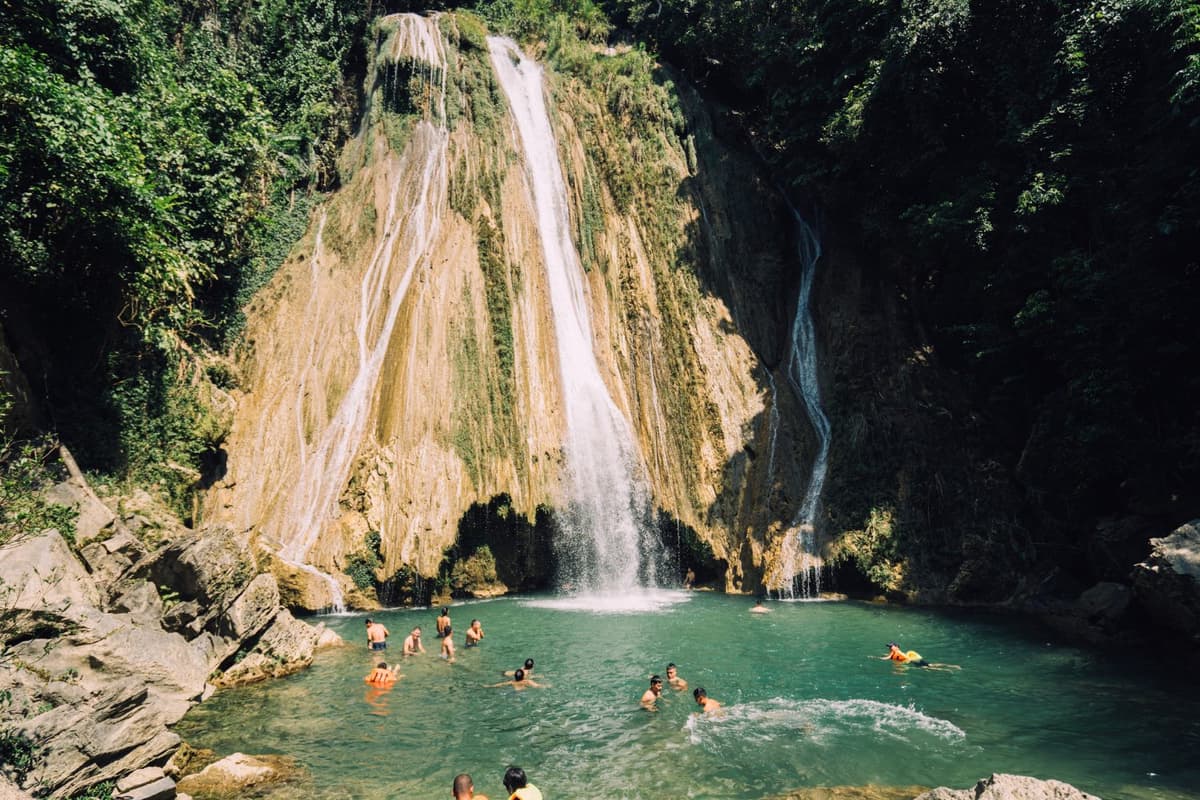
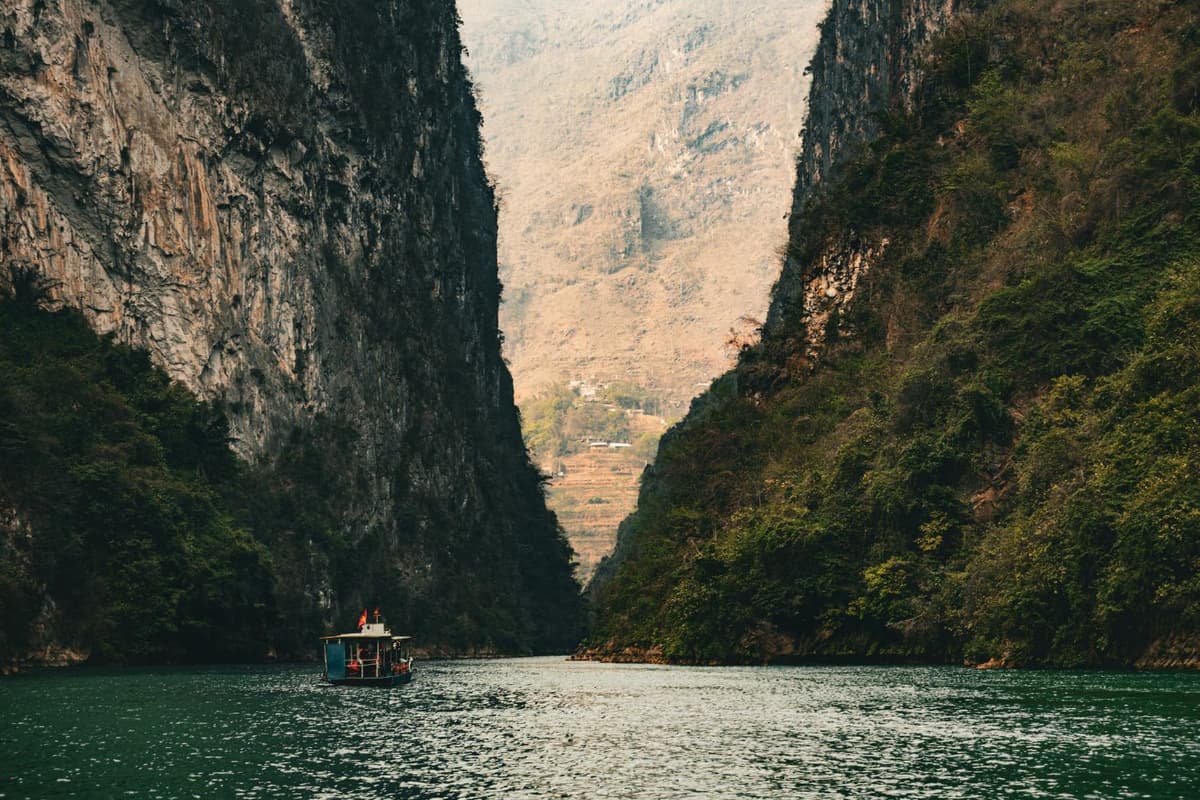
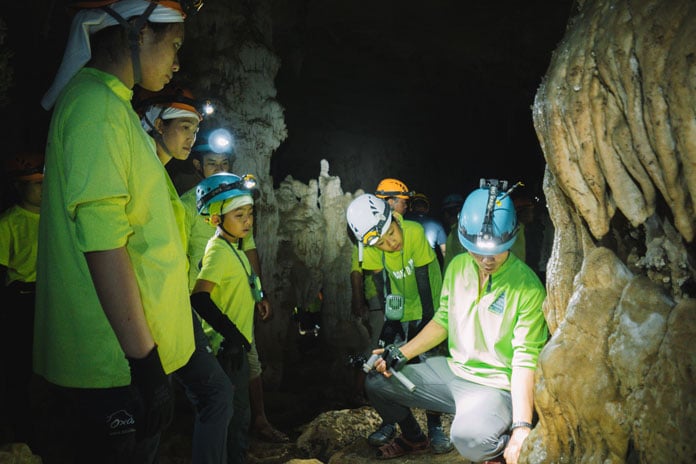
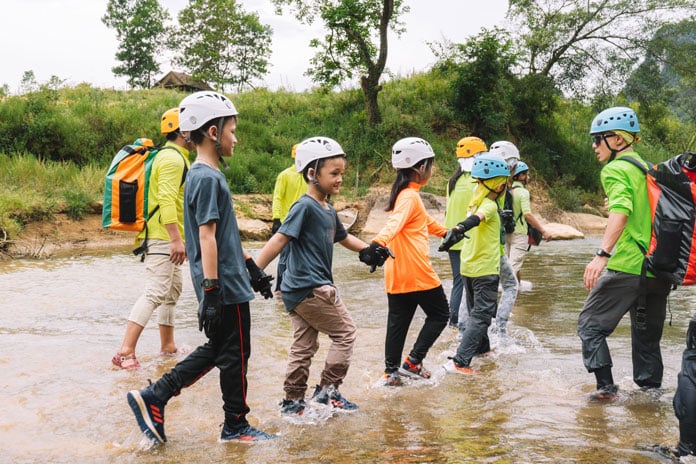
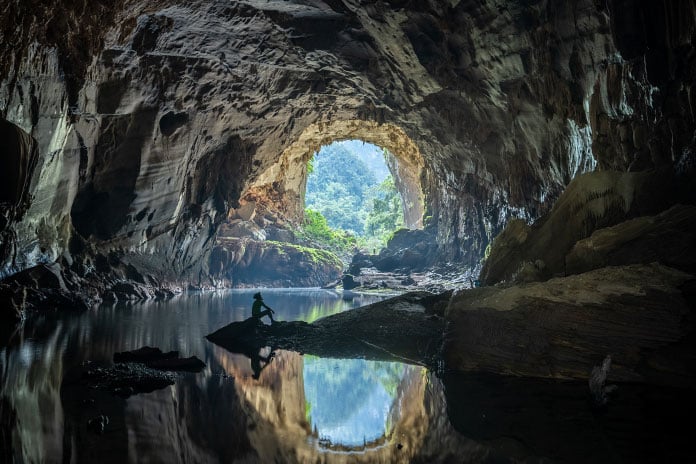
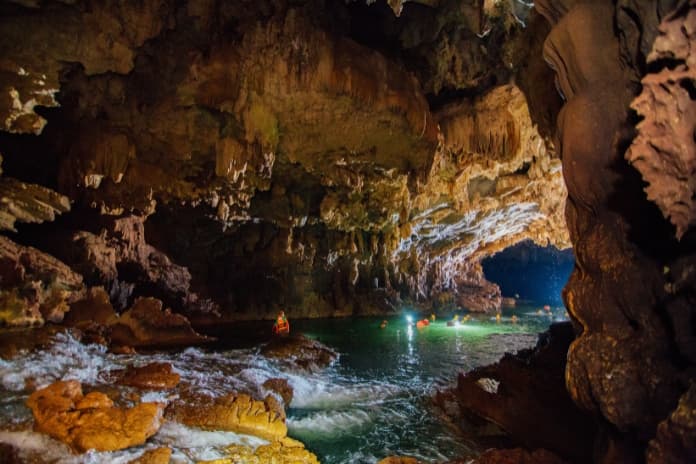
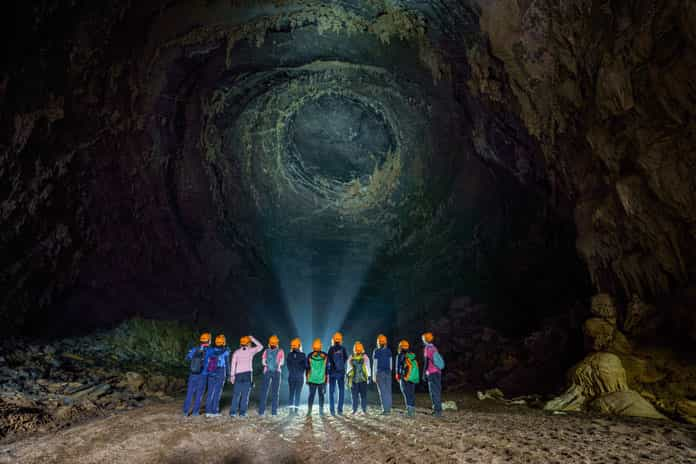
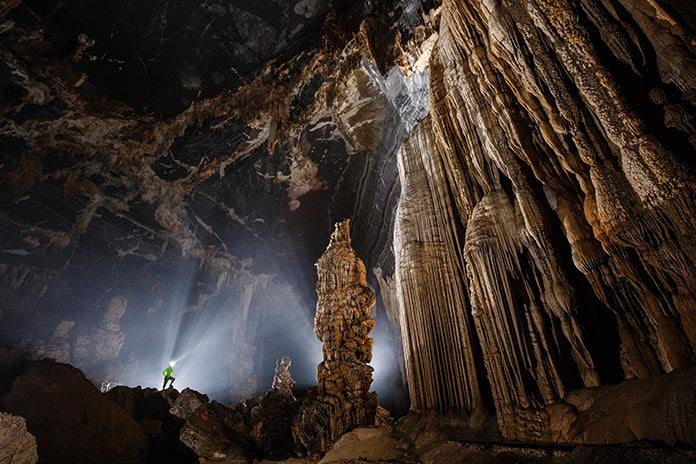
Whether you prefer long treks, camping in a cave, sleeping under the stars in the jungle, swimming underground in river caves, explore the huge dry caves or just taking an exploratory day trip, Oxalis Adventure Tours can provide the right amount of adventure just for you.
__637051782550081035.jpg)
__637051780703588520.jpg)
__637051765075307793.jpg)
__637051774329206026.jpg)
__637740499994967442.jpg)